A ball boy at Gaddafi Stadium grew into the batter Pakistan built around. That detail has followed Babar Azam for years, partly because it is neat, partly because it fits: a Lahore kid watching the game up close, then learning how to control it from the middle.
From Lahore’s cricket circles to Pakistan’s youth teams
Mohammad Babar Azam was born on October 15, 1994, in Lahore, Punjab. Cricket was close at hand from the start. He grew up in a family with strong links to the game, and his cousins Kamran Akmal, Umar Akmal and Adnan Akmal were already known names in Pakistan cricket. Their presence did not guarantee anything, but it did give him a clear path to follow.
He came through Lahore’s cricket structure and quickly moved into Pakistan’s age-group system. Babar featured in the Pakistan Under-15 World Championship in 2008, then played in the Under-19 World Cups of 2010 and 2012. At the 2012 edition he captained the side, an early sign that selectors saw not only a gifted top-order player but also someone they trusted with responsibility.
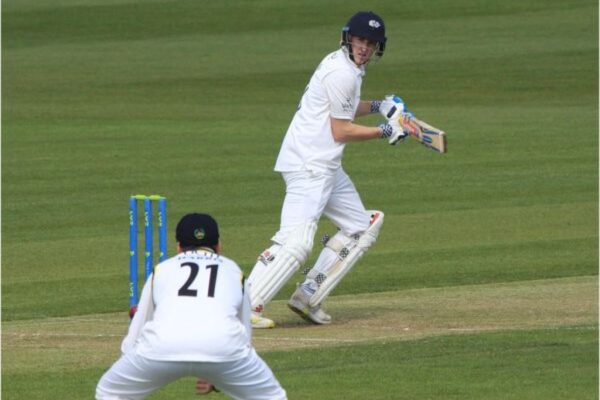
Even then, the shape of his batting was familiar: compact setup, still head, and a preference for timing over force. He was a right-handed batter first and foremost, with occasional right-arm off-breaks listed beside his name but rarely central to his role.
Domestic cricket gave him the base
Before the international spotlight, there was a long domestic apprenticeship. His first-class debut came for Zarai Taraqiati Bank Limited in 2010. Over the next several seasons he represented a range of domestic sides, including Islamabad Leopards, State Bank of Pakistan, Sui Southern Gas Corporation and later Central Punjab, whom he also captained.
That movement across teams was typical of Pakistan’s domestic structure in that period, but it also mattered for his development. He was not rushed into being a star. He scored, adjusted, and learned how to build innings in different conditions and formats.
Franchise cricket widened his profile. In the Pakistan Super League, he started with Islamabad United in the competition’s first season in 2016, then moved to Karachi Kings, where he spent the bulk of his early PSL career. Karachi’s title win in 2020 was a major moment, and Babar was named Player of the Tournament after finishing as the side’s batting anchor and most reliable run-maker.
Later came a move to Peshawar Zalmi, where he took on the captaincy as well as the top-order burden. Outside Pakistan, he also appeared in leagues such as the Caribbean Premier League, Bangladesh Premier League, England’s T20 Blast and Sri Lanka’s Lanka Premier League. Some listings also place him with Sydney Sixers in the Big Bash League, but future-team references should be treated carefully unless officially completed and recorded.
The Pakistan debut that started a surge
His ODI debut for Pakistan came against Zimbabwe in Lahore on May 31, 2015. It was a modest beginning rather than an instant breakthrough, but it opened the door to the format that would soon define much of his reputation.
A T20I debut followed against England on September 7, 2016. Then came Test cricket a month later, against West Indies in Dubai on October 13, 2016. That first Test brought an unusual footnote: Babar became the first player to score a fifty on Test debut in a day-night Test.
What followed was not a brief purple patch. It was a sustained climb. In ODI cricket especially, he moved through milestones at remarkable speed. He became the fastest batter to 1,000, 2,000, 3,000, 4,000 and 5,000 ODI runs in terms of innings, reaching 5,000 in 97 innings. For a period he also held the record for the fastest to 1,000 T20I runs, getting there in 26 innings.
Those numbers explain why the phrase Babar Azam stats so often leads people straight to ODI records. His white-ball game was built on repeatable strengths: balance at the crease, late decision-making, and the ability to keep the scoreboard moving without looking frantic.
Big tournaments and the innings that shaped his standing
Pakistan’s Champions Trophy win in 2017 gave him his first major global title with the national side. He was not yet the finished centerpiece of the batting order, but he was clearly on that path.
By the 2019 ODI World Cup, he had become central to Pakistan’s hopes. He scored 474 runs in the tournament and made a century against New Zealand, showing the ability to carry an innings on the biggest stage.
Then came the T20 World Cup in 2021, one of the defining tournaments of his captaincy years. Leading Pakistan, he scored 303 runs, the most in the event, and hit four fifties, also the most in that edition. Pakistan reached the semi-finals, and Babar was later named captain of the ICC Men’s T20 World Cup Team of the Tournament.
A year later, at the 2022 T20 World Cup, Pakistan went one step further and reached the final. His own tournament was less fluent than the one before, but his side still stayed alive long enough to make a serious run.
His record book contains some rarer entries too. He became the first and, at the time of writing, only batter to score three consecutive ODI hundreds twice. In March 2022, his 196 against Australia in Karachi became the highest fourth-innings score by a Test captain. In 2022 across all international formats, he scored 2,598 runs, the most by a Pakistan batter in a calendar year.
One claim often repeated about World Cups needs careful wording. Babar was the captain when Pakistan beat India at the 2021 T20 World Cup, making him the first Pakistan captain to defeat India in a men’s World Cup match.
Captaincy: responsibility, pressure and a step back
Leadership arrived in stages, then all at once. He became Pakistan’s T20I captain in 2019, ODI captain in 2020 and Test captain later in 2020. For a time, he was leading the side in every format while also carrying the expectations that come with being the team’s premier batter.
There were strong phases. Pakistan reached the top of the ODI rankings in May 2023 during his tenure. There were also deep tournament runs, especially in T20 World Cups. But captaincy in Pakistan rarely stays simple for long, and the role brought heavy scrutiny whenever results dipped.
In October 2023 he stepped down as Pakistan captain across formats after the ODI World Cup in India. He was later reappointed as white-ball captain in 2024. Then, on October 1, 2024, he announced that he was resigning from the limited-overs captaincy again, saying he wanted to focus more clearly on his batting and manage his workload. That sequence is important because it is more accurate than saying one uninterrupted captaincy spell simply ended in October 2024.
Why his batting stands out
The easiest way to describe Babar Azam is as a top-order batter with classical shapes and modern output. He is not a hitter in the pure power sense. He is a timer of the ball, a player who builds pressure through placement, tempo and control.
His cover drive is the stroke most often attached to his name, and fairly so. But the fuller picture is about how little seems wasted in his method. He stays balanced, gets into line early, and rarely looks rushed when in rhythm. That is why he has been effective in Tests, ODIs and T20Is without needing three completely different batting identities.
There have been periods when he ranked among the top players across formats at the same time, underlining how broad his game is. The visual comparison some fans make with other stylish batters is understandable, though Babar’s record stands on its own rather than needing aesthetic comparisons to justify it.
Awards, records and the weight of numbers
His major individual honors reflect the years when he was among the busiest and most consistent run-scorers in international cricket. He was named ICC Men’s ODI Cricketer of the Year in 2021 and 2022, then won the Sir Garfield Sobers Trophy as ICC Men’s Cricketer of the Year for 2022.
He also featured prominently in ICC teams of the year, including as captain in white-ball selections, and won multiple ICC Player of the Month awards. In Pakistan, he received the Sitara-e-Imtiaz, one of the country’s high civilian honors.
Any reader searching Babar Azam career will usually end up in the same place: a stack of runs across formats and a long list of batting milestones reached unusually quickly. The exact totals change over time, so they are best checked against current official score databases rather than fixed to a dated line in a profile. What does not change is the pattern. He has been one of Pakistan’s most productive batters of his era in Tests, ODIs and T20Is.
Off the pitch: family, Lahore and the noise around fame
Away from cricket, Babar has remained closely associated with Lahore. His father, Mohammad Azam Siddiqui, has often been mentioned as an important figure in his journey, and his family ties to cricket are well known. Those details help explain the environment he came from, though he has generally kept his private life guarded.
That privacy matters, because public figures attract rumor. Claims about a relationship have circulated in social-media posts and low-verification sources, but those reports remain unconfirmed and should be treated as rumor, not established fact.
The same caution applies to money talk. Estimates of Babar Azam net worth appear widely online, but unless they come from disclosed contracts, official filings or credible financial reporting, they remain speculative. It is fair to say he has earned through Pakistan central contracts, league deals and endorsements, including bat sponsorship, but not to present an exact figure from an unreliable source as fact.
There have also been off-field moments that became part of the wider conversation around him. He suffered a thumb injury in late 2020 that ruled him out of part of Pakistan’s tour of New Zealand. In 2023, online trolling spilled over into edits on his Wikipedia page, a reminder of how quickly digital criticism can turn juvenile. In cricket terms, a more relevant development came when he was left out of a Pakistan T20I squad in 2025, a notable selection call rather than a scandal.
Through all of that, the central story has stayed the same. From Lahore’s grounds to international captaincy, Babar Azam built his place through run-making, technical discipline and a style that made difficult batting look orderly.
FAQ
What is Babar Azam’s full name?
His full name is Mohammad Babar Azam.
When was Babar Azam born?
He was born on October 15, 1994, in Lahore, Punjab, Pakistan.
What is Babar Azam’s role in cricket?
He is a right-handed top-order batter who occasionally bowls off-spin.
Which PSL team does Babar Azam play for?
He plays for Peshawar Zalmi and has also served as the team’s captain.
Did Babar Azam captain Pakistan?
Yes. He captained Pakistan in T20Is, ODIs and Tests at different points, and had two separate spells as white-ball captain.
Has Babar Azam won major ICC awards?
Yes. He won ICC Men’s ODI Cricketer of the Year in 2021 and 2022, and the Sir Garfield Sobers Trophy for ICC Men’s Cricketer of the Year in 2022.
Photo: Nazly Ahmed, CC BY-SA 4.0, via Wikimedia Commons