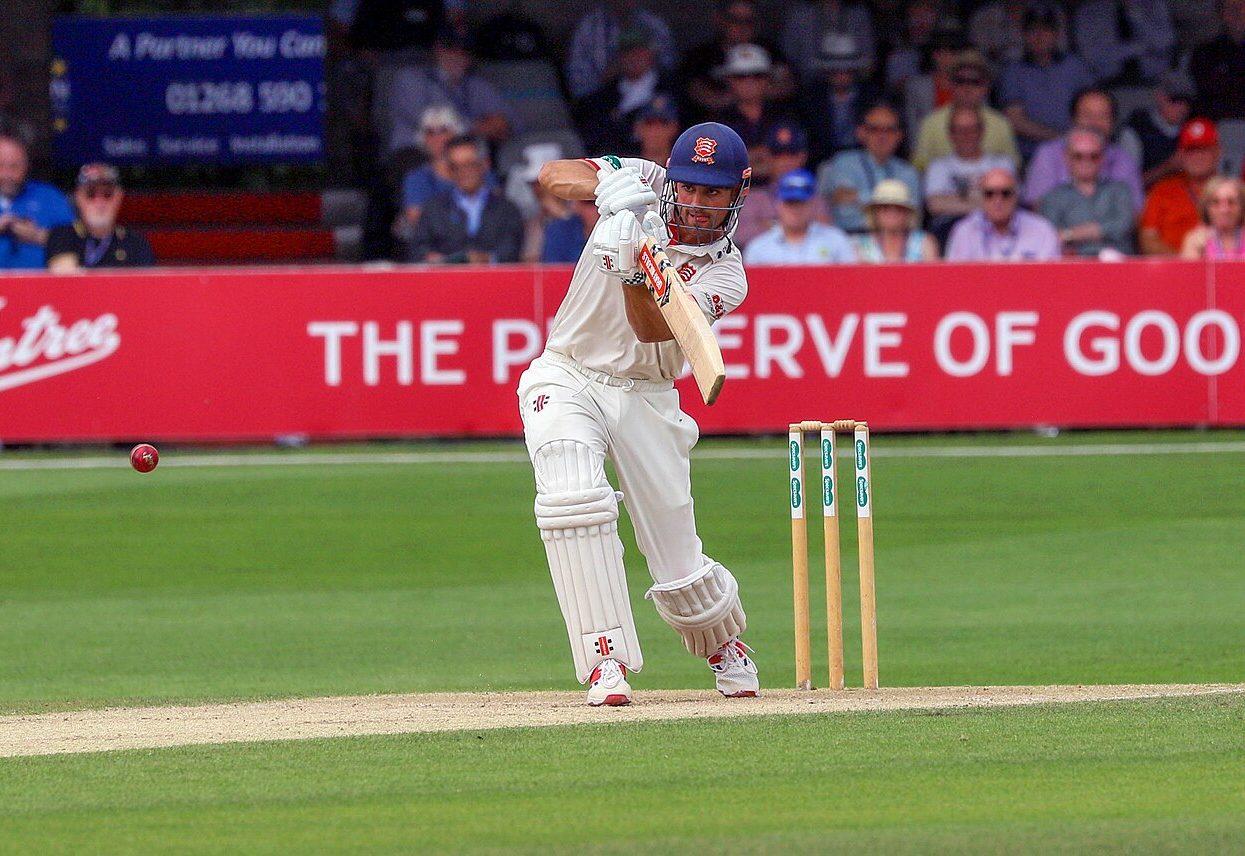
At Nagpur in March 2006, a 21-year-old Alastair Cook made 60 and an unbeaten 104 on Test debut, days after arriving in India as an emergency replacement. Twelve years later, he signed off for England with another century. Between those bookends came 12,472 Test runs, two Ashes series wins as captain and a career built on making bowlers work for his wicket.
The left-hander was rarely the most flamboyant batsman in the side. His strengths were less theatrical: judgment outside off stump, dependable scoring shots and the concentration to keep using them long after the shine had left the ball.
From the cathedral choir to county cricket
Alastair Nathan Cook was born in Gloucester on December 25, 1984. Before cricket became his profession, music gave his childhood its structure. He was a chorister at St Paul’s Cathedral between the ages of eight and 13 and also played the saxophone.
A music scholarship took him to Bedford School, where his batting increasingly demanded attention. He had joined Maldon Cricket Club in Essex at 11 and later represented Bedfordshire before making his first-class debut for Essex against Nottinghamshire in September 2003.
County cricket gave him room to develop a method that was effective rather than decorative. He could leave deliveries alone, absorb quiet passages and score heavily when an attack tired.
In 2005, he made 214 for Essex against the touring Australians. It was not a Test innings, but it was a significant demonstration of his appetite for long stays at the crease against international opposition.
A hurried arrival and a debut hundred
Cook was touring the Caribbean with England A when England called him to India in 2006 after Marcus Trescothick returned home. The journey was hurried; his batting was anything but.
His debut began on March 1 at Nagpur. After scoring 60 in the first innings, he made 104 not out in the second, becoming the latest England batsman to score a century on Test debut. He looked comfortable with the format’s central bargain: patience now could bring runs later.
His ODI debut followed against Sri Lanka on June 28, 2006, and his first T20I came against West Indies exactly a year later. Neither format would define him. Across his international career, he played 161 Tests, 92 ODIs and just four T20Is.
There were difficult spells, particularly when bowlers exposed uncertainty around his off stump. Yet England persisted with him, and his ability to recover became almost as important as his ability to accumulate.
Australia changed the scale of his career
Cook had already been part of England’s Ashes-winning team in 2009, but the 2010-11 tour of Australia transformed his standing.
He scored 766 runs at an average of 127.66 as England won the series 3-1, their first Ashes series victory in Australia since 1986-87. His unbeaten 235 at Brisbane helped turn a precarious position into a draw. Hundreds at Adelaide and Sydney then contributed to innings victories.
These were not runs gathered after matches had lost their edge. They helped change the direction of the series.
Back home in 2011, he made his highest Test score, 294 against India at Edgbaston. The innings occupied more than 12 hours and underlined his particular value: once established, he could force an opposition to spend whole sessions searching for a breakthrough.
Captaincy brought victories-and difficult decisions
Cook first captained England in Tests as a stand-in during the 2010 Bangladesh tour. He took over permanently from Andrew Strauss in 2012, beginning with a demanding assignment in India.
England lost the opening Test but recovered to win the series 2-1. Cook scored centuries in each of the first three matches, supplying the runs around which the comeback was built. It was England’s first Test series victory in India since 1984-85.
Ashes victories followed under his captaincy in 2013 and 2015. Between them came a bruising 5-0 defeat in Australia in 2013-14. His leadership record contains both experiences; presenting only the home celebrations would miss much of the job.
He captained England in 59 Tests, with his final match in charge coming in December 2016. He stepped down in February 2017.
His one-day captaincy covered 69 matches and included England’s run to the 2013 Champions Trophy final, where they lost narrowly to India. However, his place in the ODI side became increasingly contested, and he was removed as captain in December 2014, before the following World Cup.
The method behind the numbers
Cook’s batting relied on repeatable movements rather than a vast range of strokes. He scored strongly through the leg side, worked balls off his hip and punished short bowling with the pull and cut. He was willing to leave-and willing to look unhurried while doing it.
His technique was not beyond criticism. Bowlers could draw him into playing outside off stump, and lean periods sometimes made his movements look awkward. What distinguished him was the capacity to adjust without abandoning his basic game.
Physical endurance supported that approach. So did availability: he played a record 159 consecutive Tests, an extraordinary sequence for an opener facing the new ball.
At international retirement, his record stood at:
| Format | Matches | Runs | Average | Hundreds | Fifties |
|---|---|---|---|---|---|
| Test | 161 | 12,472 | 45.35 | 33 | 57 |
| ODI | 92 | 3,204 | 36.40 | 5 | 19 |
| T20I | 4 | 61 | 15.25 | 0 | 0 |
He left as England’s leading Test run-scorer and century-maker, although Joe Root subsequently surpassed both totals. In June 2018, Cook also became the youngest player to reach 12,000 Test runs.
Bowling remained an occasional diversion. His sole Test wicket was India’s Ishant Sharma, caught down the leg side at Trent Bridge in 2014.
One last hundred, then back to Essex
Cook’s final Test, against India at The Oval in September 2018, supplied a farewell few players get to arrange. He scored 71 in the first innings and 147 in the second as England won the match.
International retirement did not mean putting away his bat. Essex had remained his county throughout his England career, and he returned to a fuller domestic schedule.
He was part of their County Championship-winning teams in 2017 and 2019, then made 172 against Somerset in the 2020 Bob Willis Trophy final. Essex secured the trophy after a draw, having earned a first-innings lead.
His final retirement came in October 2023, ending a professional career that had begun two decades earlier. Across all first-class cricket, he scored 26,643 runs and 74 centuries.
Recognition extended beyond the boundary. He received a CBE in 2017 and a knighthood in 2019, the same year his autobiography was published.
Family, farming and a different place in cricket
The farm was not a retirement reinvention. Cook had already made it part of his life while playing for England.
He married Alice Hunt in 2011, and the couple have three children. Their publicly discussed family life centres on a working farm in Bedfordshire, where practical jobs offer a different rhythm from touring, training and waiting to bat.
That background makes his life away from cricket more distinctive than a list of hobbies. The former cathedral chorister became an international captain, then returned from overseas tours to farm work. Music, livestock and opening the batting are an unusual combination, but all belong to his story.
His charity work also has a personal connection. He is a patron of the David Randall Foundation, established in memory of his childhood friend to support people with life-limiting illnesses and their families.
Cricket remains part of his working life through broadcasting, including BBC Radio’s Test Match Special and television punditry. From the commentary box, he now examines the decisions he once had to make in the middle: which ball to leave, when to attack and how to survive a spell when batting stops feeling straightforward.
FAQ
How many Test runs did Alastair Cook score?
He scored 12,472 runs in 161 Tests, averaging 45.35, with 33 centuries. His highest score was 294 against India in 2011.
When did he retire?
He retired from international cricket in September 2018 and from professional cricket with Essex in October 2023.
Did he win the Ashes as England captain?
Yes. He captained England to home Ashes series victories in 2013 and 2015.
Who is Alastair Cook’s wife?
He married Alice Hunt in 2011. They have three children and have publicly discussed their family life on a Bedfordshire farm.
Why is he called “Chef”?
“Chef” is a play on his surname. “Cookie” and “Captain Cook” are other familiar nicknames.
Photo: Kroome111, CC BY-SA 4.0, via Wikimedia Commons