At Old Trafford in 2005, Michael Vaughan drove, cut and pulled his way to 166 against Australia. England could not quite force victory in that third Ashes Test, but their captain had made his largest batting contribution to a series that would end an 18-year wait for the urn.
The summer became the defining chapter of his career, though it can obscure how good a batsman he had been before taking charge. Vaughan reached number one in the world Test batting rankings, scored three centuries on an Ashes tour of Australia and finished with 5,719 Test runs. Captaincy gave his career its biggest stage; batting had earned him a place there.
From Lancashire to a Yorkshire apprenticeship
Michael Paul Vaughan was born on October 29, 1974, in Eccles, Greater Manchester. His family moved to Sheffield when he was a child, and cricket took root through his father, Graham, a club cricketer, and his older brother, David.
Sheffield Collegiate provided an early grounding. Yorkshire followed, with Vaughan making his first-class debut in 1993 and representing England Under-19s during the 1993-94 season.
His progress was steady rather than spectacular. The right-hander looked a natural stroke-player, but attractive shots did not immediately translate into the weight of runs needed for England selection. He spent six years learning county cricket before receiving his first Test cap.
Yorkshire remained his only county throughout his professional career. He was part of their 2001 County Championship-winning side, although international duties increasingly pulled him away from the team that had developed him.
A difficult introduction, then a remarkable breakthrough
Vaughan’s Test debut came against South Africa in Johannesburg on November 25, 1999. England slipped to 2 for four on the opening morning. Walking into that collapse, he made 33: an unremarkable score on paper, but a useful demonstration that he could withstand a difficult examination.
His ODI debut followed against Sri Lanka on March 23, 2001. Later that year, in a Test against India in Bangalore, he acquired a less welcome distinction when he was dismissed “handled the ball” after picking it up while it remained in play.
The breakthrough came in 2002. Across the calendar year, Vaughan scored 1,481 Test runs at an average of 61.70. During England’s seven-Test home summer alone, he made 900 runs, including 197 and 195 against India.
These were not merely pleasing innings. He was staying in long enough to shape matches.
Australia then supplied a tougher test. England lost the 2002-03 Ashes 4-1, but their opening batsman scored 633 runs at 63.30, with centuries in Adelaide, Melbourne and Sydney. Against an attack featuring Glenn McGrath and Shane Warne, his balance and timing survived scrutiny that exposed much of England’s batting.
He reached the top of the Test batting rankings during that tour. The PCA Player of the Year award for 2002 and selection as a Wisden Cricketer of the Year in 2003 reflected the same transformation: a promising county batsman had become an accomplished international opener.
Taking over England
When Nasser Hussain stepped down from the respective roles, Vaughan became England’s ODI captain and then Test captain in 2003.
He inherited a side that had become harder to beat under Hussain and coach Duncan Fletcher. The next task was to turn that resilience into sustained victories. Vaughan brought a calm manner and a willingness to trust attacking players, even when their methods involved risk.
Results gathered momentum. England won all seven home Tests against New Zealand and West Indies in 2004, then secured a 2-1 series victory in South Africa in 2004-05.
There was progress in limited-overs cricket too. England reached the 2004 Champions Trophy final, only for West Indies to recover from eight wickets down and win at The Oval.
On June 13, 2005, Vaughan captained England in their first men’s T20 international, against Australia at Southampton. England won by 100 runs. His own T20I career would amount to only two appearances, a small footnote beside the Test campaign that followed.
The Ashes summer that defined his captaincy
England began the 2005 Ashes with a heavy defeat at Lord’s. Against an Australian side accustomed to controlling these contests, it was an ominous start.
Vaughan’s team responded at Edgbaston, winning by two runs in a finish that left almost nobody sitting comfortably. A draw at Old Trafford followed, despite his first-innings 166, before England won another close match at Trent Bridge.
At The Oval, Kevin Pietersen’s final-day century helped secure the draw England needed. The series finished 2-1, bringing the Ashes back for the first time since 1987.
Vaughan’s contribution extended beyond his own runs. He managed an attack built around Andrew Flintoff, Steve Harmison, Matthew Hoggard and Simon Jones, with Ashley Giles providing spin and control. His field settings and bowling changes mattered, but so did his ability to keep a tense campaign from overwhelming the dressing room.
He was appointed OBE in the 2006 New Year Honours, following the Ashes victory.
Injuries and the end of the playing career
The triumph did not lead to an uninterrupted second act. Persistent knee trouble kept Vaughan out of Test cricket throughout 2006, including the return Ashes series in Australia, which England lost 5-0 under Flintoff.
He returned to Test cricket in 2007, scoring a century against West Indies at Headingley. Selection in the ICC Test Team of the Year that year offered further recognition, but maintaining form and fitness became increasingly difficult.
After the 2007 World Cup, he relinquished the ODI captaincy. In August 2008, following England’s series defeat by South Africa, he stepped down as Test captain too. His final Test had come at Edgbaston during that series.
He finished with 26 victories from 51 Tests as captain, an England record at the time. On June 30, 2009, he retired from professional cricket after an unsuccessful attempt to regain his international place through Yorkshire.
The batting behind the captain
Across 82 Tests, Vaughan scored 5,719 runs at 41.44, with 18 centuries and 18 fifties. His highest score was 197.
His ODI figures were less imposing: 1,982 runs in 86 matches at 27.15, including 16 fifties but no centuries. In two T20Is, he scored 27 runs.
Test cricket suited his strengths. He could leave well, wait for the ball and punish width without appearing hurried. His cover drive was especially distinctive, while his pull shot allowed him to score against fast bowlers who tried to push him back.
Alongside Marcus Trescothick, he helped give England an opening partnership capable of putting pressure back on an attack. Later, batting in the middle order accommodated both the team’s needs and his captaincy.
His right-arm off-breaks were occasional rather than central, bringing six Test wickets and 16 in ODIs. He was selected to make runs and, eventually, to make decisions.
Broadcasting, family and cricket-ball paintings
Retirement moved Vaughan from the dressing room to the microphone. Through commentary and punditry, including work for BBC Test Match Special, he remained closely involved in the game. His broadcasting style has generally been more outspoken than his manner as captain: conversational, teasing and ready with a firm opinion.
Away from broadcasting, his business interests have included FITISM fitness ventures and Declaration Gin, launched in 2019. A more unusual project, Art Balling, used cricket balls to create paintings-a distinctly literal way of taking batting beyond the boundary.
Vaughan married Nichola Shannon in 2003, and they have three children. Their son Archie followed him into professional cricket, making his first-class debut for Somerset in 2024. The family connection had long supplied lighter material: Vaughan once joked that being bowled by a three-year-old Archie had helped convince him it was time to retire.
Football provides another lasting allegiance. He supports Sheffield Wednesday, a connection to the city where he grew up rather than the Lancashire town where he was born.
He also carried the Olympic torch in 2012. Between broadcasting, business and family cricket, retirement proved less a departure from public life than a change of setting.
FAQ
Where was Michael Vaughan born?
He was born in Eccles, Greater Manchester, England, on October 29, 1974, and grew up in Sheffield.
How many Test runs did he score?
He scored 5,719 runs in 82 Tests at an average of 41.44, including 18 centuries.
Did Michael Vaughan captain England to an Ashes victory?
Yes. He led England to a 2-1 victory over Australia in 2005, their first Ashes series win since 1987.
When did he retire?
He retired from professional cricket on June 30, 2009. His final England appearance had been in a Test against South Africa in August 2008.
Who is his wife, and does his son play cricket?
He married Nichola Shannon in 2003. They have three children, including Archie, who made his first-class debut for Somerset in 2024.
What did he do after retirement?
He moved into cricket commentary and punditry, alongside business interests in fitness, gin and cricket-inspired art.
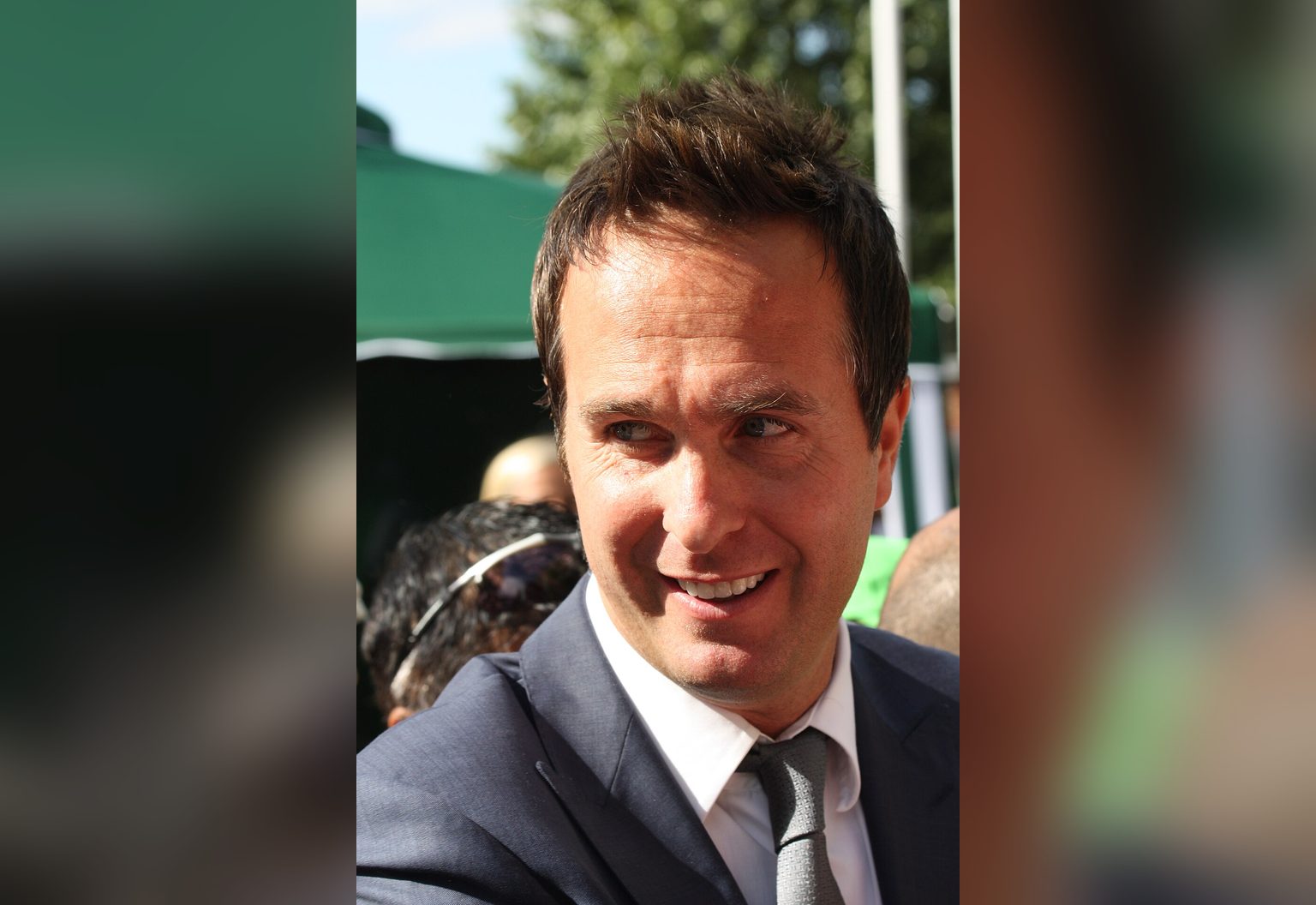
Photo: Gareth Williams from Redhill, England, CC BY 2.0, via Wikimedia Commons