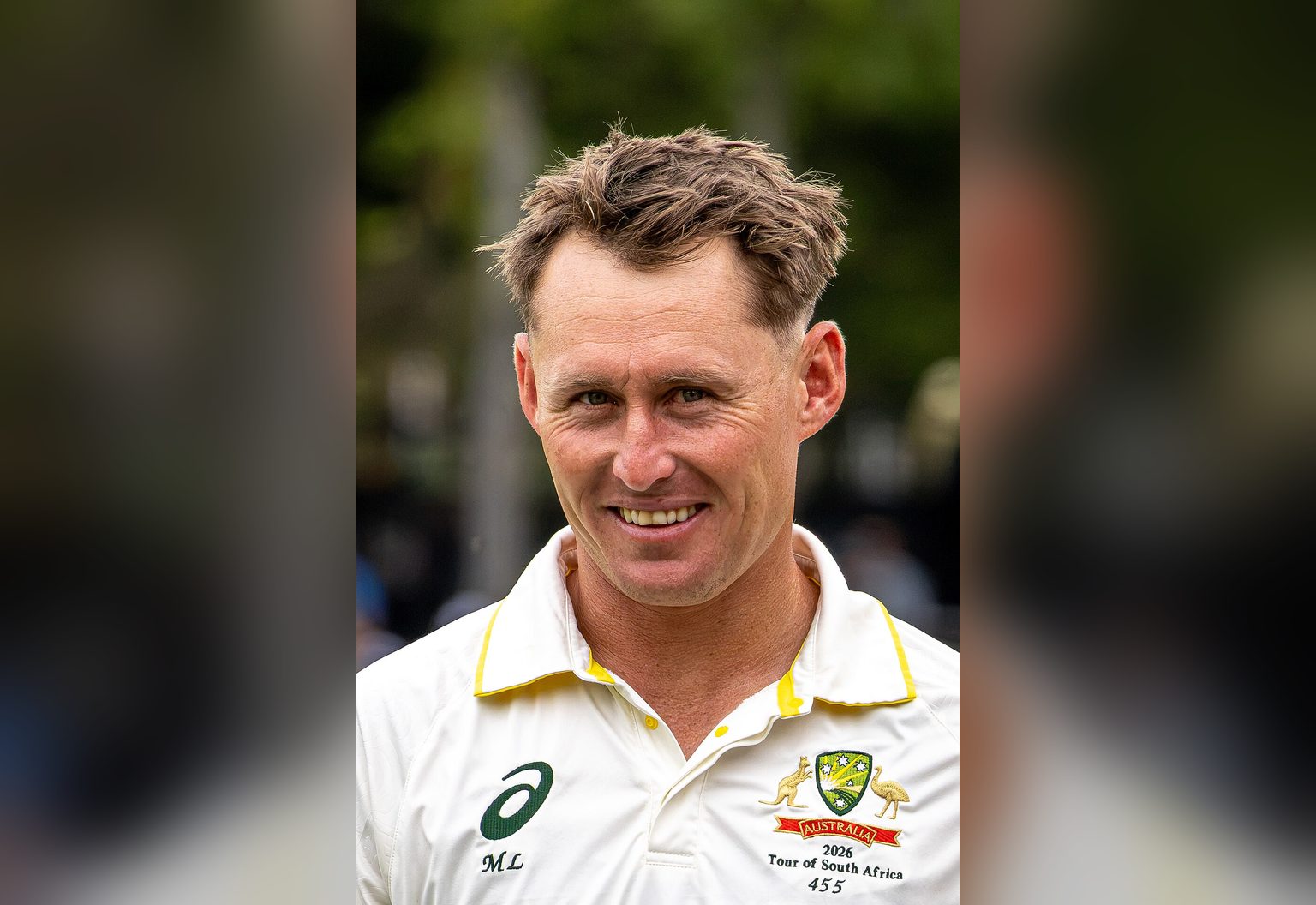
At Lord’s in August 2019, Marnus Labuschagne walked into an Ashes Test through a door nobody had used before. Steve Smith had been ruled out with concussion after being struck by Jofra Archer, and Australia needed a replacement. Labuschagne became Test cricket’s first concussion substitute, made 59 and helped save the match.
He finished that year as the world’s leading Test run-scorer. For a batter whose selection had initially owed something to his useful leg-spin, the transformation was striking.
The route there ran from an Afrikaans-speaking childhood in South Africa to Queensland, then through county cricket in Wales. Along the way, he developed the habits that would become familiar to international audiences: constant movement, conversations with himself and an apparently inexhaustible desire to bat.
From Klerksdorp to the Gabba
Born on June 22, 1994, in Klerksdorp, South Africa, Labuschagne moved to Australia with his family in 2004. He was 10 and spoke Afrikaans; learning English was part of settling into his new home.
Cricket provided continuity. In Queensland, he progressed through state age-group teams and captained the under-19 side during the 2012-13 season. His ambitions were already firmly attached to Australia.
One early encounter with Test cricket came from behind a camera rather than a bat. During the opening Ashes Test at the Gabba in 2010, he worked as a Hot Spot camera operator and witnessed Peter Siddle’s hat-trick. Years before sharing an Australian dressing room, he was helping television viewers follow the action.
English club cricket also played a part in his education. At Sandwich Town in 2014, he scored 1,049 runs, setting a Kent Premier League season record.
Queensland gives him his start
Labuschagne made his first-class debut for Queensland against South Australia in October 2014. His early senior seasons offered evidence of ability rather than an immediate rush towards international selection.
Recognition arrived in one-day cricket. He was named player of the tournament in the 2016 Matador One-Day Cup, and his Brisbane Heat debut followed during the 2016-17 Big Bash League season.
There was an unusual footnote in September 2017. Playing against Cricket Australia XI, he pretended to throw a ball he had not collected. Queensland conceded five penalty runs under the newly introduced fake-fielding law. It was an on-field penalty, not a suspension.
More substantial progress came with Queensland’s 2017-18 Sheffield Shield title. He was building a reputation as an energetic fielder and a busy right-handed batter whose leg-spin offered another route into a side.
That combination helped take him onto Australia’s Test tour of the United Arab Emirates.
A Test debut, then a Welsh turning point
His Test debut came against Pakistan in Dubai on October 7, 2018. It was an uneven introduction: a duck in his first innings, followed by 13 in the second, although his bowling produced useful wickets across the series.
He was not yet an established international batter. The next important step came at Glamorgan in 2019.
County cricket gave him repeated opportunities to construct long innings in unfamiliar conditions. He became the first batter to reach 1,000 runs in that season’s County Championship, turning a promising signing into a compelling case for Ashes selection.
The Welsh connection mattered beyond the numbers. Regular cricket allowed him to refine his technique and build confidence without the stop-start rhythm of being on the edge of an international team. Glamorgan became a recurring part of his career rather than a brief overseas assignment.
He entered the Ashes squad with runs behind him. At Lord’s, an unexpected opportunity put that preparation to the test.
The substitute who stayed
Replacing Smith was no ordinary assignment. Australia were under pressure, Archer was bowling fast, and Labuschagne was struck on the helmet early in his innings.
He recovered to make 59. The innings was not a match-winning hundred, but it showed enough composure to change his standing within the side.
When Smith returned, Australia found room for both men. Labuschagne finished the 2019 Ashes with 353 runs at an average of 50.42, helping Australia retain the urn in a drawn series.
Back home, he turned starts into much larger scores. His maiden Test century was 185 against Pakistan at the Gabba in November 2019. Hundreds followed in Adelaide and Perth.
He ended the calendar year with 1,104 Test runs, more than any other batter. In January 2020, he extended that run with 215 against New Zealand in Sydney, his first Test double-century.
The awards followed: ICC Men’s Emerging Cricketer of the Year for 2019, Australia’s men’s Test Player of the Year in 2020, and selection among Wisden’s five Cricketers of the Year that April. In December 2021, he reached No. 1 in the ICC Test batting rankings.
Two different routes to world titles
Labuschagne made his ODI debut against India in Mumbai on January 14, 2020. Establishing himself in the 50-over side proved less straightforward than securing his Test place.
His controlled accumulation could hold an innings together, but selection also depended on Australia’s balance and the demands of particular conditions. Before the 2023 World Cup, his place was uncertain.
An unbeaten 80 against South Africa in September 2023, made after entering as a concussion substitute for Cameron Green, helped revive his case. He was subsequently included in the final World Cup squad when the injured Ashton Agar was ruled out.
By then, he had already helped Australia win the World Test Championship, beating India at the Oval in June 2023.
The ODI World Cup final in Ahmedabad required a very different innings. Chasing 241 against India, Australia slipped to 47 for three. Labuschagne joined Travis Head and supplied the restraint while his partner attacked.
Their fourth-wicket partnership was worth 192. Head made 137; Labuschagne finished unbeaten on 58 from 110 balls as Australia won by six wickets.
The scorecard captured his contribution neatly. This was not an innings built for spectacle, but it was precisely what the chase required.
His T20I debut had come against Pakistan in April 2022, although international T20 cricket has occupied a much smaller part of his career than Tests and ODIs.
Restless at the crease, serious about preparation
Labuschagne’s batting rarely looks quiet, even when the scoring slows. He leaves balls with exaggerated movements, talks himself through passages of play and reacts audibly to deliveries.
Behind those mannerisms is a technically demanding job. At No. 3 in Tests, he may face a new ball almost immediately or arrive after a substantial opening partnership. His game depends on judging length, defending accurately and remaining patient enough to make bowlers return to him.
He scores particularly well through the off side and is quick to punish anything short. His fielding adds value, while leg-spin-and occasional medium pace-provides supplementary bowling rather than the foundation of his international role.
Queensland appointed him captain for the 2024-25 season, adding formal leadership to a domestic career that had already included Sheffield Shield titles in 2017-18 and 2020-21.
Family, faith and a proper cup of coffee
Away from cricket, some of Labuschagne’s best-documented interests are less complicated than his batting routines.
He married Rebekah Gillam in May 2017. The couple publicly announced the birth of their daughter, Hallie, in September 2022. Beyond such shared milestones, family life does not need to become a catalogue of private details.
He has also spoken openly about his Christian faith, describing it as an important source of perspective. His public charitable work includes an ambassador role with Compassion Australia.
Coffee is another enduring interest. He completed a barista course as a young adult and has taken that enthusiasm into business through The Run Club Coffee Co.
It is a fitting off-field pursuit for someone so absorbed by preparation: equipment, technique and small adjustments all matter. Unlike a Test innings, though, the result can be ready in a few minutes.
FAQ
Where was Marnus Labuschagne born?
He was born in Klerksdorp, South Africa, on June 22, 1994. His family moved to Australia in 2004, and he represents Australia internationally.
Why was his appearance at Lord’s in 2019 historic?
He became Test cricket’s first concussion substitute, replacing Steve Smith during the Ashes. He scored 59 in Australia’s second innings.
What is his highest Test score?
His highest Test score is 215, made against New Zealand at the Sydney Cricket Ground in January 2020.
Has he won a World Cup?
Yes. He helped Australia win the 2023 ODI World Cup, scoring an unbeaten 58 in the final against India. He also played in Australia’s 2023 World Test Championship-winning team.
Who is his wife?
His wife is Rebekah Labuschagne, née Gillam. They married in May 2017.
Which domestic teams has he represented?
His principal domestic teams include Queensland, Brisbane Heat and Glamorgan. Queensland appointed him captain for the 2024-25 season.
Photo: EGilham, CC BY-SA 4.0, via Wikimedia Commons