160.4 km/h is the number that still jumps off Mitchell Starc’s record. So do the wickets: more than 400 in Tests, a World Cup edition with 27 scalps, and a habit of making top orders look vulnerable inside the first over.
That combination explains his place in Australian cricket. Starc was never just a fast bowler who filled a role. He became the left-arm quick captains turned to when they needed a breakthrough, a yorker at the death, or a burst that changed the shape of a match.
From junior wicketkeeper to left-arm quick
Mitchell Aaron Starc was born on January 30, 1990, in Baulkham Hills, New South Wales. His route into the game was not the obvious one. As a child, he began as a wicketkeeper in Sydney grade and junior cricket, playing through the Northern Districts Junior Cricket Association and also featuring for clubs including Berala Sports Cricket Club and Western Suburbs.
Somewhere along the way, the gloves gave way to the ball. The switch mattered. At 197 cm, Starc offered something unusual once he focused on pace bowling: a tall left-armer who could hit the deck hard, swing the new ball and, later, reverse the old one.
Cricket and sport ran through the family. His father, Paul Starc, played for the New South Wales Second XI, while his brother Brandon Starc built his own career as an Olympic high jumper. Another detail from those early years stayed with him in public life: at age nine, he met Alyssa Healy while playing junior cricket against her. Years later, that childhood link would become one of Australian cricket’s best-known partnerships.
By 2007, he had made the New South Wales under-17 side. The raw ingredients were there, but the finished bowler would take shape through domestic cricket.
New South Wales, Yorkshire and a rare domestic feat
Starc made his first-class debut for New South Wales against Western Australia in March 2009. That remained the central thread of his domestic career. New South Wales was home base, the place where his pace, angle and wicket-taking instincts were sharpened over long spells rather than short highlights packages.
There were stints elsewhere. He played county cricket for Yorkshire in 2012, adding English conditions to his education, and in the Big Bash League he turned out for the Sydney Sixers in the early years of the competition before returning later in his career.
One domestic performance still stands apart. In November 2017, playing Sheffield Shield cricket for New South Wales against Western Australia, Starc took a hat-trick in each innings. It made him the first bowler in Australian first-class cricket to claim two hat-tricks in the same match. For a bowler known for destructive bursts, it felt perfectly in character.
Australia debut and the first signs of a match-winner
His international career began in ODI cricket, with a debut against India in Visakhapatnam in October 2010. The Test debut followed against New Zealand in Brisbane in December 2011. He played his first T20I against Pakistan in September 2012.
Early on, the appeal was obvious. Starc had pace, but not pace alone. He could swing the white ball at high speed, attack the stumps from over and around the wicket, and produce the kind of full delivery that leaves batters late and leg stumps flat. In red-ball cricket, he added bounce and reverse swing. In all formats, he looked like a bowler built to take wickets rather than merely contain.
That attacking style brought risk with it. There were expensive spells, especially in shorter formats, and periods when rhythm deserted him. But Australia kept going back to him because the upside was so high. He could break open games in a handful of overs.
The making of a major Test bowler
Starc’s Test career developed into one of the strongest ever put together by a left-arm fast bowler. He moved beyond the label of white-ball specialist and became a central figure in Australia’s attack across conditions.
His Ashes work was a good example. In 2015, he was Australia’s leading wicket-taker in the series, using pace and full swing to trouble England’s top order. Later tours and home series brought injuries, comebacks and workload management, but the pattern held: when fit, he remained one of Australia’s most dangerous strike bowlers.
In 2015, he also produced the fastest recorded ball in Test cricket, clocked at 160.4 km/h against New Zealand. Speed alone does not define his career, but it captured the threat he posed when everything clicked.
The milestones kept coming. He passed 400 Test wickets and moved past Wasim Akram to become the most successful left-arm bowler in Test history. That was not simply a longevity record. It reflected how often he was used as an attacking option, trusted to force results rather than drift through overs.
He also contributed valuable lower-order runs. Starc was never picked for his batting, but he became a stubborn and sometimes counterattacking No. 8 or No. 9, capable of changing the tempo with clean hitting and useful partnerships.
ODI cricket and the World Cup stage
If Test cricket made him complete, ODI cricket made him unmistakable. This was the format in which Mitchell Starc built some of his most striking numbers and most memorable tournament spells.
He became the fastest bowler to 100 ODI wickets, reaching the mark in 52 innings in 2016. Later, he was also the fastest to 200 ODI wickets, getting there in 102 matches. Those records suited the eye test. Starc was not collecting wickets through attrition; he was taking them early, often before an innings had settled.
World Cups became his stage. In 2015, on home soil, he was central to Australia’s title run and was named Player of the Tournament. Four years later, at the 2019 Cricket World Cup, he set a tournament record by taking 27 wickets in a single edition. It remains one of the standout campaigns by any fast bowler in ODI history.
He added a second 50-over World Cup winner’s medal in 2023. By then, the outline of his ODI career was clear: new-ball menace, death-overs yorkers, and a record that placed him among Australia’s most effective one-day bowlers.
T20Is, franchise choices and the IPL
Starc’s T20I career was shorter than his time in Tests and ODIs, but it still included a major title. He was part of Australia’s squad for the 2021 T20 World Cup triumph, giving him an ICC trophy in each international format when combined with the ODI World Cup and World Test Championship success.
Unlike some fast bowlers of his era, he was selective with franchise cricket for long stretches. That made each IPL return a talking point. He played for Royal Challengers Bangalore in 2014 and 2015 and showed how dangerous he could be with the white ball in Indian conditions.
Then came the auction headline. Kolkata Knight Riders signed him for IPL 2024 for INR 24.75 crore, at the time a record fee in the competition. He later moved to Delhi Capitals for IPL 2025.
That selective approach said something about how he managed his career. Starc often prioritized Australia commitments and workload over a year-round franchise schedule, a choice that helped shape the balance of his later years.
What made Starc different
Plenty of bowlers have been quick. Plenty have swung the ball. Fewer have combined left-arm angle, high pace, bounce, reverse swing and a world-class yorker in one package.
That is what made Starc such a difficult problem. Right-handers had to deal with the ball tailing back into the stumps at speed. Left-handers had to handle awkward angles across them and the threat of the fuller ball. When conditions offered reverse swing, he became even more dangerous.
He could be expensive. He could search a little too hard for the magic ball. But that was part of the same bargain. Australia accepted the occasional loose over because his best spells won sessions and, often, matches.
Life off the pitch
Away from cricket, Starc’s public life has largely been defined by family, property and a relatively low-key profile for a player of his stature.
He married Alyssa Healy in April 2016. Their story is well known because it began in childhood cricket, and later they became the first married couple to both play Test cricket for Australia. It is one of those rare sporting details that sounds polished enough for fiction but happens to be true.
His family background remains part of the picture too. Paul Starc’s cricketing past and Brandon Starc’s athletics career point to a household steeped in elite sport.
There has also been regular media coverage of property moves involving Starc and Healy, including homes in Breakfast Point, Mosman and North Curl Curl, and later the Charlotte Park estate in Terrey Hills. Those purchases and sales were widely reported, though property coverage naturally depends on public records and media reporting rather than personal disclosure from the couple.
As for wealth, various outlets have published estimates of Mitchell Starc net worth, but those figures are only estimates and not audited public accounts. The same caution applies to endorsement tallies and annual income reports. What is clear is that his commercial profile has included major cricket contracts and sponsorship deals with brands such as Kookaburra, Asics and Audi.
He has also been linked with charitable and community work, including fundraising support for The Chappell Foundation and involvement in campaigns tied to Lifeline Australia.
Edge, intensity and the occasional flashpoint
Fast bowlers rarely build long international careers without confrontation, and Starc is no exception. During Australia’s 2018 tour of South Africa, he was involved in heated on-field exchanges, including one with Theunis de Bruyn, and there were also reported disagreements during the series about tactical approaches.
Those moments fit the broader picture of a hard-edged competitor rather than opening some separate controversy chapter. His cricket was aggressive, and so was his presence in the contest.
The shape of his legacy
A profile of Mitchell Starc finally comes back to impact. He struck early. He cleaned up tailenders. He changed white-ball games with yorkers and red-ball matches with reverse swing. He won major tournaments and kept taking wickets long enough to move into historic territory among left-arm quicks.
That is a substantial body of work: a New South Wales fast bowler who began behind the stumps, found his true trade with the ball in hand, and spent much of his career making batters feel hurried.
FAQ
What is Mitchell Starc’s fastest ball?
His fastest recorded delivery in Test cricket was 160.4 km/h, bowled against New Zealand in 2015.
Is Mitchell Starc married?
Yes. He married Australian cricketer Alyssa Healy in April 2016.
How many World Cups has Mitchell Starc won?
He has won two ODI World Cups with Australia, in 2015 and 2023, and was also part of Australia’s 2021 T20 World Cup-winning squad.
Did Mitchell Starc start as a wicketkeeper?
Yes. In junior cricket, he initially played as a wicketkeeper before switching to fast bowling.
Has Mitchell Starc taken two hat-tricks in one match?
Yes. He did it for New South Wales in a Sheffield Shield match against Western Australia in November 2017.
Which IPL teams has Mitchell Starc played for?
He has played in the IPL for Royal Challengers Bangalore, Kolkata Knight Riders and Delhi Capitals.
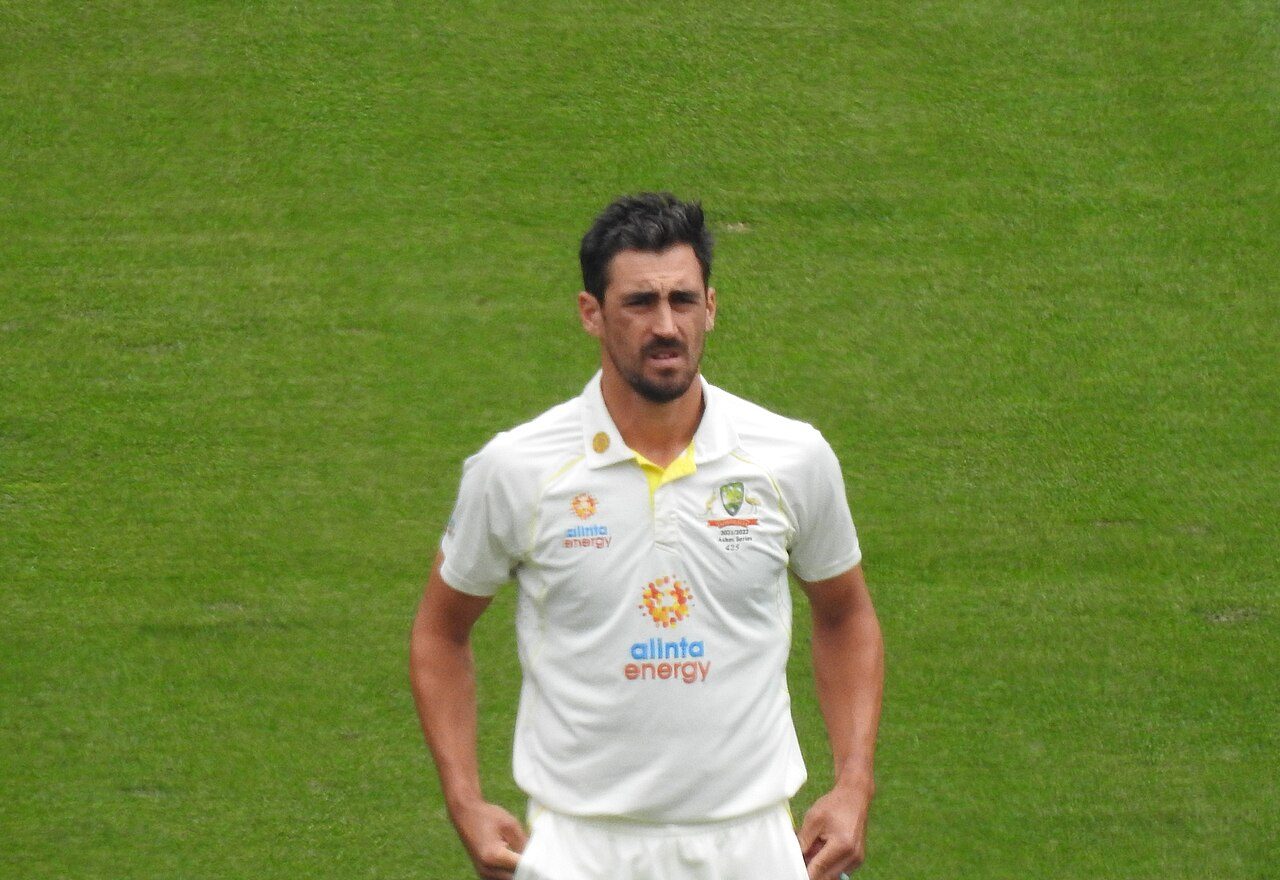
Photo: SirWellsy99, CC BY-SA 4.0, via Wikimedia Commons