David Andrew Warner was born on October 27, 1986, in Paddington, Sydney, and grew up in the city’s strong grade-cricket system. He played junior cricket with Sydney Coastal and was already in first grade for Eastern Suburbs while still a teenager, a sign of how quickly his talent was moving him through the ranks.
One early story has followed him for years because it says something about the player he became. As a boy, he was encouraged by a coach to try batting right-handed. His mother pushed him back toward his natural left-handed game, and that stuck. The result was the attacking, hand-speed-heavy style that later became familiar around the world.
Even in those early days, Warner was not a batter who eased into an innings. He liked to score square of the wicket, drove hard, cut fiercely and put pressure on fielders with quick running. He represented Australia at Under-19 level, but his path to the top still broke with convention.
The debut that came before first-class cricket
Australia picked Warner for the white-ball side in January 2009 without any first-class experience, making him the first Australian in 132 years to debut internationally before playing a first-class game. It was a gamble by selectors, but the logic was clear enough once he started swinging.
His T20I debut against South Africa in Melbourne remains one of the most memorable starts by an Australian batter. Warner blasted 89 from 43 balls and reached his fifty in 19 deliveries. It was not a novelty act either. The innings showed the shape of his game: strong base, fast hands, willingness to hit in front of square and no interest in waiting for permission.
The longer-format step came soon after. In March 2009, he made his first-class debut for New South Wales against Western Australia. That sequence, Australia first, state cricket second, still looks strange on paper, but it became the foundation of a career that expanded far beyond T20 hitting.
From white-ball dasher to Test opener
The next question was obvious: could Warner make the jump to Test cricket? He answered it quickly enough.
He made his Test debut against New Zealand at Brisbane in December 2011. A month later, at Hobart, he scored his first Test hundred, a brisk century that underlined what Australia believed they had found. He was not simply a short-format specialist being tried in whites. He was an opener capable of changing the tempo of a Test match.
Over time, Warner built a substantial red-ball record. He scored runs at speed, but he also learned when to leave, when to absorb pressure and when to cash in. His best Test innings often came when he combined his natural aggression with discipline at the start of a knock.
Among the biggest was his unbeaten 335 against Pakistan at Adelaide in 2019, the second-highest individual Test score by an Australian man, behind only Matthew Hayden’s 380. It was the sort of innings that would have seemed unlikely when he first arrived as a T20 disruptor.
By the time he finished in Test cricket, Warner had played 112 matches and scored 8,786 runs at an average of 44.59, with 26 centuries.
ODI and T20I success for Australia
Warner’s white-ball record was every bit as important to Australia as his Test work. In ODIs, he developed from an explosive starter into a high-volume run-scorer who could dominate powerplays and still bat deep into an innings.
He played 161 ODIs and made 6,932 runs at 45.30, including 22 centuries. At the 2019 Cricket World Cup, he scored 647 runs, the second-most in the tournament. Four years later, during Australia’s title-winning 2023 World Cup campaign, he was again central at the top of the order, finishing as the side’s leading run-scorer with 535.
His T20I career began with that famous debut and lasted long enough for him to become one of Australia’s defining players in the format. He made 3,277 runs in 110 T20Is at a strike rate above 140, with one century and 28 fifties. That hundred came against Sri Lanka in Adelaide in October 2019.
Warner was also part of one of Australia’s most productive T20I opening combinations. With Shane Watson, he put together 1,158 runs for the first wicket, which stood for a long time among the format’s leading opening partnerships.
World Cups, major titles and the biggest stages
For all the bilateral runs, Warner’s career is also measured by tournament success.
He was part of Australia’s squad for the 2015 Cricket World Cup win on home soil and then added another ODI World Cup title in 2023. In between came the 2021 T20 World Cup, where he was named Player of the Tournament after scoring 289 runs, and the 2023 World Test Championship final victory over India at The Oval.
That gave him a place in a relatively small group of players to win the ODI World Cup, T20 World Cup and World Test Championship.
Some of his best one-day tournament innings came in the 2019 World Cup, where he made 166 against Bangladesh and 153 against Pakistan. Those knocks made him the first player to score two 150-plus innings in a single men’s World Cup.
The difficult chapters
Warner’s career was not a smooth rise from start to finish, and any accurate profile has to leave room for that.
In 2013, he was stood down before the first Ashes Test after punching Joe Root in a Birmingham bar. Cricket Australia sanctioned him, and the incident became an early warning about the volatility that sometimes sat alongside his competitiveness.
The far more serious controversy came in Cape Town in 2018, during the ball-tampering scandal widely known as Sandpapergate. Warner was found to have played a central role in the plot to alter the ball during the Test against South Africa. Cricket Australia banned him from international and domestic cricket for 12 months and barred him from leadership positions in Australian cricket. The episode remains inseparable from his public story.
He returned in 2019 and resumed scoring heavily, particularly in the World Cup that followed soon after. The comeback did not erase the scandal, but it did show the scale of his resilience as a cricketer.
Domestic cricket, BBL and the IPL journey
Warner’s domestic base for most of his Australian career was New South Wales. In the Big Bash, he was originally aligned with Sydney Thunder, spent the 2012-13 season with Sydney Sixers, and later returned to the Thunder.
His IPL career was even more significant. He began with Delhi Daredevils in 2009 and stayed until 2013. In 2014, he moved to Sunrisers Hyderabad, and that became one of the defining franchise partnerships of the era.
At Sunrisers, Warner was not just a prolific scorer; he was the batting engine of the side. He captained the team to the 2016 IPL title and won the Orange Cap three times, in 2015, 2017 and 2019. Few overseas batters have had a longer or more consistent impact on the league.
He returned to Delhi, now Delhi Capitals, in 2022. Across his IPL career, Warner established himself among the competition’s most productive openers, regularly combining fast starts with enough control to bat long.
Beyond Australia and India, he has also appeared in franchise leagues elsewhere, including stints in the BPL and Global T20 Canada. Some reports have linked him with PSL involvement as well, though franchise listings can change quickly and should be read in that context.
Awards, records and playing style
Warner’s honours reflect both longevity and range. He won the Allan Border Medal three times, in 2016, 2017 and 2020. He was named Bradman Young Cricketer of the Year in 2012, Australian Test Player of the Year in 2016, and Australian ODI Player of the Year in 2017 and 2018.
At ICC level, he was selected multiple times in annual Test and ODI teams and was later named in the ICC Men’s Test Team of the Decade and ODI Team of the Decade for the 2011-2020 period.
As a batter, Warner was easy to identify but harder to reduce to one trait. The aggression came first, of course. He liked to seize the first over rather than survive it. But his best cricket rested on more than force. He had quick hands, sharp balance, strong placement through point and cover, and the ability to adjust late enough to score off good-length bowling. That is a big part of why he could thrive in T20Is and still make double and triple hundreds in Tests.
Off the pitch: family, books and public life
Away from cricket, Warner’s family life has long been visible. He married Candice Warner, formerly Candice Falzon, in 2015, and they have three daughters.
He has also built a public profile beyond the game. Warner is the author of The Kaboom Kid children’s book series, a project that fits neatly with the playful side he often showed on social media.
Some business and wealth claims around him are harder to verify cleanly. Estimates of David Warner net worth vary widely by source, and figures published online should be treated as estimates rather than confirmed fact. The same applies to several reported investments and commercial interests that have been attributed to him in entertainment, hospitality, real estate and sport.
His charity work is better documented. Warner and his wife have been involved in fundraising for Sydney Children’s Hospital, and he has also been linked with support for Make-A-Wish, The Chappell Foundation and other causes connected to children and families.
There have also been entertainment crossover reports. Warner was reported to have made a cameo appearance in the Telugu film Robinhood. As with many celebrity-payment claims, reported fee figures have circulated in the media but are not always independently confirmed.
Retirement from Tests and ODIs
Warner brought his Test career to a close after the home series against Pakistan, finishing his red-ball career in January 2024. He also confirmed his retirement from ODI cricket around the same period, ending two formats in which he had been a fixture for more than a decade.
That left behind a career with an unusual beginning and a very full middle: a national debut before first-class cricket, major runs in all formats, ICC titles, franchise success, and controversies serious enough to alter how his career will always be remembered.
FAQ
When did David Warner retire from Test and ODI cricket?
He retired from Test cricket in January 2024 and also confirmed his ODI retirement at the same time.
What made David Warner’s debut so unusual?
He debuted for Australia in white-ball cricket before playing a first-class match, the first Australian to do so in 132 years.
How many World Cups did David Warner win?
He was part of Australia’s winning squads in the 2015 and 2023 ODI World Cups and the 2021 T20 World Cup. He also won the 2023 World Test Championship.
What was David Warner’s highest Test score?
His highest Test score was 335 not out against Pakistan in Adelaide in 2019.
Was David Warner involved in the ball-tampering scandal?
Yes. He was sanctioned for his role in the 2018 Cape Town ball-tampering scandal and received a 12-month ban.
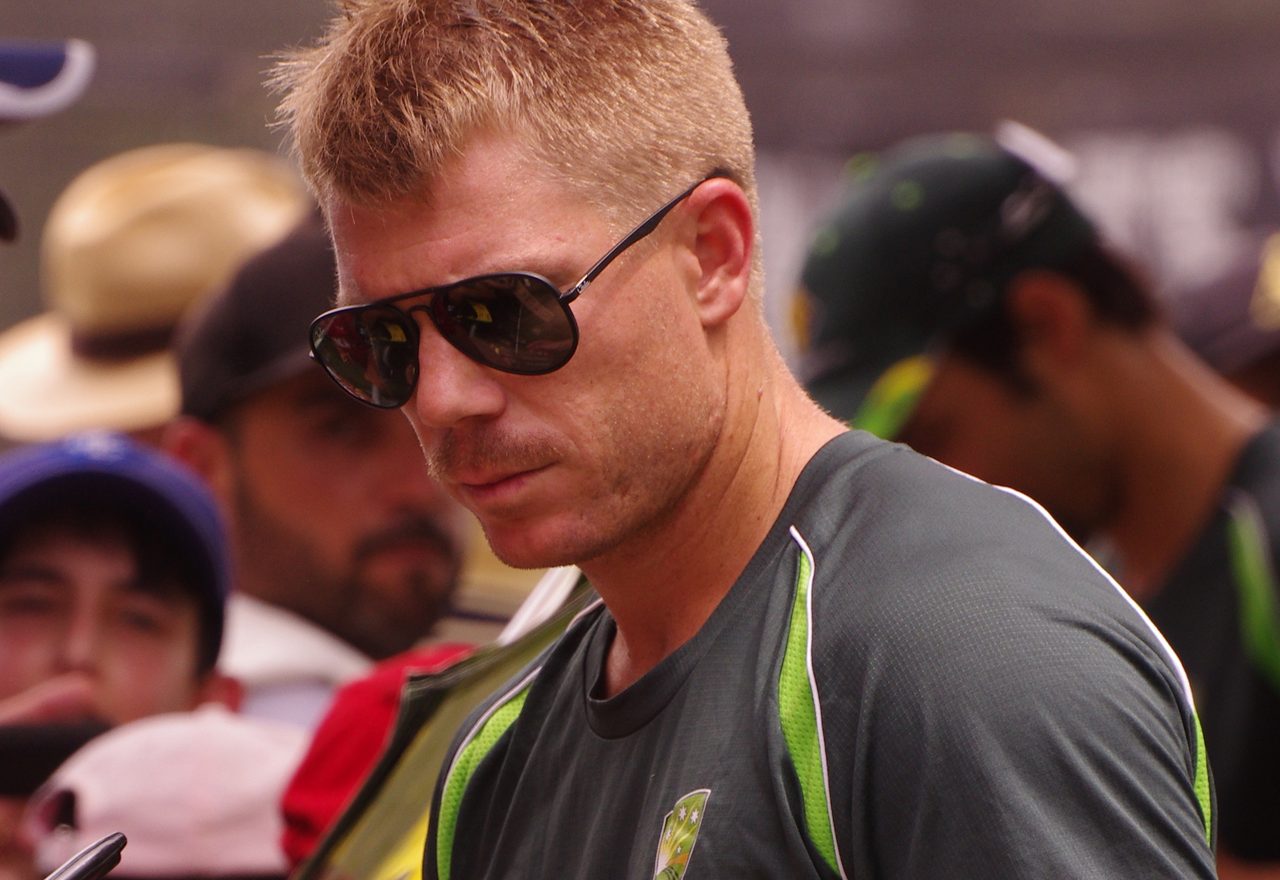
Photo: Original photograph: NAPARAZZI Crop: Ham105, CC BY-SA 2.0, via Wikimedia Commons