Seven hours at the crease in Adelaide told the cricket world almost everything it needed to know about Faf du Plessis. On Test debut against Australia in November 2012, he made an unbeaten 110, batted through pressure and fatigue, and saved the match for South Africa. It was not a flashy introduction. It was a stubborn, high-class one, and it set the tone for a career built on control, nerve and adaptability.
Francois “Faf” du Plessis was born in Pretoria on July 13, 1984. A right-handed batter and occasional leg-break bowler, he grew into one of South Africa’s most dependable all-format players, later captaining the national side and becoming the first South African to score centuries in Tests, ODIs and T20Is.
Pretoria roots and the long road up
Du Plessis came through Afrikaans Boys’ High School in Pretoria, a well-known sporting nursery, and later studied at the University of Pretoria. He represented South Africa at Under-19 level, but his rise was not especially fast or dramatic. There was no teenage rush into the senior side. Instead, his game developed through domestic cricket, where patience and consistency mattered.
One detail from those early years has followed him throughout his career: his long friendship with AB de Villiers. The two played together from a young age in Pretoria, and that connection remained part of the story once both reached the South African team.
His domestic cricket began with Northerns, and he also became a key player for the Titans. A stint with Todmorden in the Lancashire League in 2007 broadened his experience, and in 2008 he signed a Kolpak deal with Lancashire. At that stage, an England-based future looked possible. Reports at the time suggested he considered that route, but he ultimately kept his focus on South Africa.
County cricket, the Titans and a life in franchises
Before he became one of the game’s best-known T20 travellers, du Plessis had already built a reputation for fitting into different teams and conditions. He played county cricket for Lancashire and later turned out for Kent, while still maintaining strong links with the Titans setup back home.
His franchise career became one of the defining features of his later playing life. In the IPL, he first played for Chennai Super Kings, then spent two seasons with Rising Pune Supergiant when Chennai were suspended, before returning to CSK. That second Chennai spell brought major rewards. He was part of title-winning sides in 2018 and 2021, and in the 2021 final he was named Player of the Match after making 86 from 59 balls against Kolkata Knight Riders.
From there, he moved to Royal Challengers Bangalore, now Royal Challengers Bengaluru, and took over as captain. The role suited him. Even late in his career, he remained a high-output top-order batter, strong against pace, sharp against spin and calm in chases.
Away from the IPL, his passport filled quickly. Du Plessis played in Australia’s Big Bash League, the Pakistan Super League, the Caribbean Premier League, The Hundred, SA20, Major League Cricket, the Lanka Premier League and the Abu Dhabi T10. That list is long, but the pattern is simple: teams kept turning to him because he brought order. He could open, bat at No. 3, finish an innings if needed, and set standards in the field.
One landmark in franchise cricket came in SA20, where he scored the competition’s first century, making 113 not out for Johannesburg Super Kings. In Major League Cricket, he also became one of the tournament’s early standout batters.
The South Africa breakthrough
Du Plessis made his ODI debut against India in Cape Town in January 2011 and marked it with an unbeaten 60. It was a composed start, and that quality, the ability to settle a chase or hold an innings together, soon became central to his value.
He was part of South Africa’s squad at the 2011 Cricket World Cup, though his bigger international breakthrough came later. His T20I debut arrived against England in September 2012. Then came Adelaide.
That Test hundred against Australia was more than a debut milestone. South Africa were under pressure, and du Plessis, drafted in after JP Duminy’s injury, played one of the great rearguard innings by a debutant. He became the fourth South African to score a century on Test debut, but the number only tells part of the story. What mattered was the temperament.
Test career: grit first, runs after
Across 69 Tests, du Plessis scored 4,163 runs at an average of 40.02, with 10 centuries. He retired from Test cricket in February 2021.
The numbers are solid; the shape of the innings often mattered even more. He was a batter who could absorb pressure for long periods, especially overseas, and he rarely looked rushed by the moment. His highest Test score, 199 against Sri Lanka in Centurion, was a reminder that he could do much more than survive. He could dominate too.
He also collected some unusual records. He became the first South African to score centuries in all three international formats, and he was the first player to score centuries in all three formats at the same venue, Johannesburg. In 2016, he became the first captain to score a century in a day-night Test innings.
Not every headline was positive. In 2013, during a Test against Pakistan in Dubai, he was fined 50 percent of his match fee after being found guilty of ball tampering. It remained one of the more controversial episodes of his international career.
ODI cricket and captaincy
If Test cricket showed his patience, ODI cricket showed his range. Du Plessis played 143 ODIs and scored 5,507 runs at an average of 46.65, with 12 centuries. His highest score was 185 against Sri Lanka in Cape Town, one of the highest ODI scores by a South African batter.
His first ODI hundred came against Zimbabwe in 2014, not Australia. That matters because du Plessis’s one-day record was built on accumulation as much as impact. He was rarely wasteful, especially once set, and he was excellent at pacing an innings through the middle overs before accelerating late.
Leadership became a major chapter of his career. He first captained South Africa in T20Is, then took over the Test side in late 2016, and later led in all formats. In ODI cricket, his record as captain was particularly strong: 28 wins in 39 matches, a win percentage of 73.68.
Some of his best results came against Australia. Under du Plessis, South Africa won an ODI series in Australia in 2016 and then whitewashed Australia 5-0 at home in ODIs later that year. His side also won Test series against Australia both home and away during his leadership period, a significant achievement given the rivalry and the conditions involved.
At the 2019 Cricket World Cup, he captained South Africa and finished as the team’s leading run-scorer with 387. His final ODI came later that year.
T20Is and a game built for modern cricket
In T20 internationals, du Plessis played 50 matches and scored 1,528 runs at an average of 35.53, with one century. That hundred, 119 against West Indies in Johannesburg, completed his set across formats and made him the first South African man to reach three-format international centuries.
He was named the ICC Men’s T20I Cricketer of the Year in 2015, recognition for a format in which his game often looked deceptively simple. He was not a batter of constant invention. He was a batter of timing, placement and control. He found gaps, ran hard and punished errors.
His last T20I came in December 2020. After stepping away from Test cricket, he left the door open to white-ball international cricket, but his career increasingly shifted toward the franchise circuit.
How Faf du Plessis played
At his best, du Plessis made difficult innings look measured. He could bat in the top order or slide into the middle order, and he was especially good at reading match tempo. Against fast bowling, he was compact and balanced. Against spin, he used his wrists well and worked the ball square with precision.
He also offered occasional leg-breaks, though bowling was always a secondary skill at international level.
In the field, he was outstanding. Quick across the ground, safe under the high ball and athletic inside the ring, he was one of South Africa’s best fielders of his era. That part of his game helped explain why teams kept trusting him well into his late 30s and beyond. Even when conditions were awkward or the match was tight, he rarely looked flustered.
Life off the pitch
Off the field, du Plessis has generally kept a controlled public image, much like his batting. He is married to Imari Visser, and Pretoria has remained an important base in his life. He has also spoken at times about family, including his upbringing after his parents separated when he was young.
He has been linked with business and brand work beyond cricket. Some reports have mentioned property and investment interests, as well as partnerships and endorsements with sporting and betting-related brands. As with many athlete wealth stories, figures around Faf du Plessis net worth vary widely by source and should be treated as estimates rather than verified fact.
A few lighter details help round out the picture. He is known to enjoy Formula 1, speaks both Afrikaans and English, and has often been described by teammates as disciplined in training and preparation. He has also been involved in mentoring younger players, something that fits the leadership role he carried for much of his career.
One frightening off-field-adjacent moment came in the PSL in 2021, when he suffered a concussion after colliding with a teammate while fielding. It was a sharp reminder that even one of cricket’s safest fielders can be vulnerable in a split second.
A career defined by composure
Plenty of players score more quickly. Plenty have louder careers. Du Plessis built his on something else: trust. Coaches trusted him to steady an innings. Captains trusted him in the ring. Franchises trusted him to travel, adapt and perform.
That is why the Adelaide hundred still feels like the right place to start. It was not just a debut century. It was the clearest early sign of what Faf du Plessis would become.
FAQ
Is Faf du Plessis retired from international cricket?
He retired from Test cricket in February 2021. His last ODI was in 2019 and his last T20I was in 2020.
What are Faf du Plessis’s highest international scores?
His highest Test score is 199 against Sri Lanka, his highest ODI score is 185 against Sri Lanka, and his highest T20I score is 119 against West Indies.
Which IPL teams has Faf du Plessis played for?
He has played for Chennai Super Kings, Rising Pune Supergiant and Royal Challengers Bengaluru. He was later also associated with Delhi Capitals in franchise discussions and squad planning, depending on the competition cycle.
Did Faf du Plessis captain South Africa?
Yes. He captained South Africa in T20Is, then Tests, and later led the side across formats.
How many international centuries did Faf du Plessis score?
He scored 10 Test centuries, 12 ODI centuries and one T20I century.
Was Faf du Plessis involved in a ball-tampering case?
Yes. He was fined 50 percent of his match fee during a 2013 Test against Pakistan after being found guilty of ball tampering.
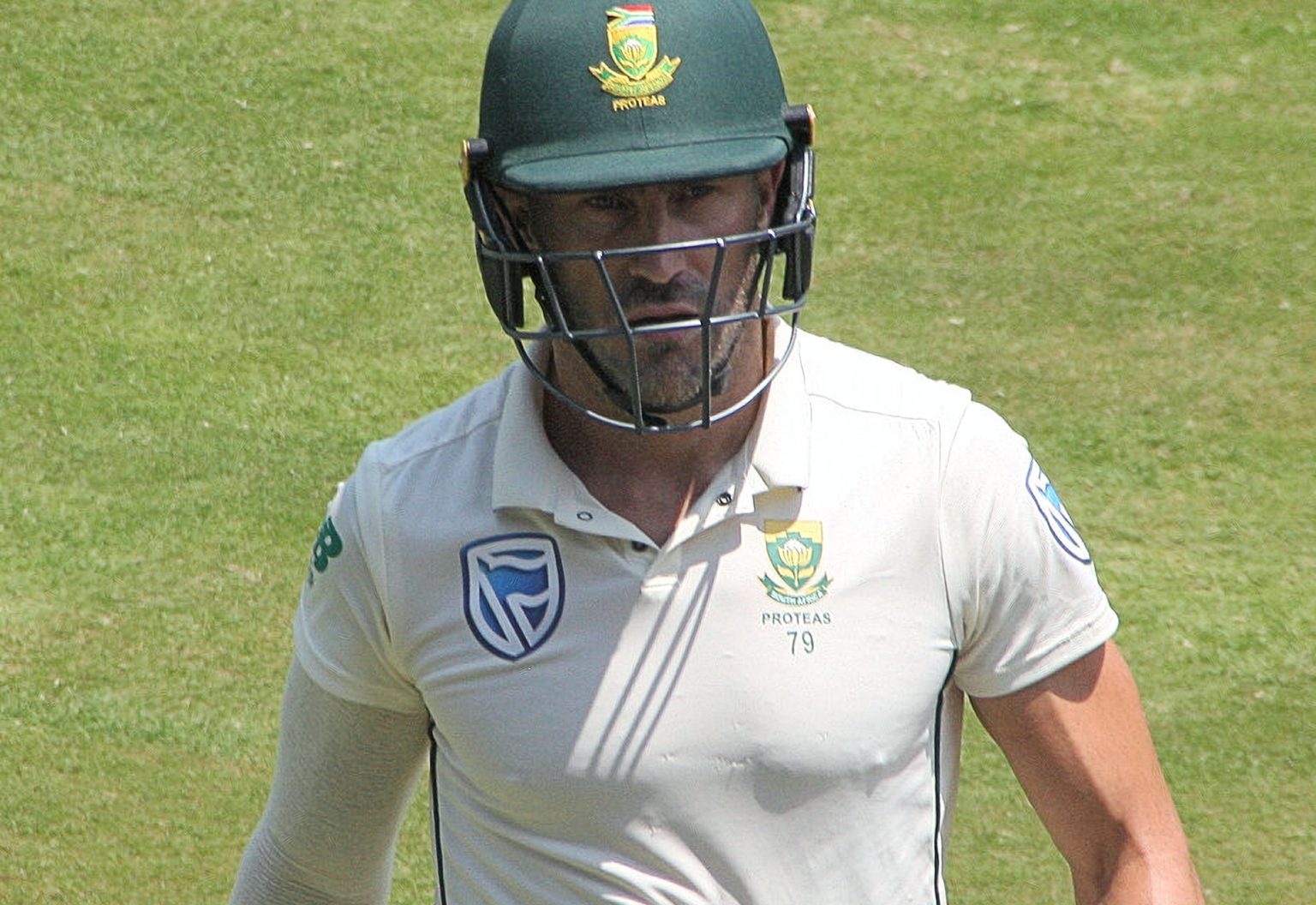
Photo: Dave Morton, Public domain, via Wikimedia Commons