A one-rupee coin on top of the stumps became an early prize worth fighting for. At Shivaji Park in Mumbai, coach Ramakant Achrekar would challenge young batters to survive a session; if they did, they kept the coin. Sachin Tendulkar collected 13 of them, and the story endures because it fits the cricketer he became: compact, obsessive, difficult to dislodge.
Sachin Ramesh Tendulkar was born on April 24, 1973, in Bombay, now Mumbai, Maharashtra. His father, Ramesh Tendulkar, was a Marathi poet and novelist; his mother, Rajni Tendulkar, worked in insurance. The family influence that mattered most to his cricket, though, came from his elder half-brother Ajit, who spotted both the talent and the restless energy, then took him to Achrekar.
At Sharadashram Vidyamandir, cricket quickly became the center of his days. Tendulkar’s school years are part of Mumbai cricket folklore, especially his huge partnership with Vinod Kambli in the Harris Shield. Just as important was the discipline built around those runs: long practice sessions, match after match, and a technique sharpened early against older bowlers. There was even a brief attempt to turn him into a fast bowler at the MRF Pace Foundation, until Dennis Lillee advised him to focus on batting instead.
That turned out well for everyone except bowlers.
Mumbai made him, and he announced himself immediately
The first-class debut arrived in December 1988 for Bombay against Gujarat, and he marked it with a century. It was the first clear sign that the schoolboy stories would survive the jump into senior cricket. He would also score centuries on debut in the Ranji Trophy, Duleep Trophy and Irani Trophy, a rare early sequence that underlined how smoothly he moved through Indian domestic cricket.
Even then, his batting already had the features that would define it for decades: balance at the crease, quick judgment of length, and the ability to play equally well off front foot and back foot. The straight drive became his signature not because it was ornamental, but because it was so precise. When he hit through mid-off or back past the bowler, the shot seemed to arrive from perfect alignment rather than brute force.
He was a specialist batter first and foremost, a right-hander who could bat in the top order and, in one-day cricket, become one of the game’s great openers. But he also bowled enough to matter: right-arm medium pace, leg-spin and off-spin, often used to break partnerships or change a rhythm that had gone stale.
A teenage debut against Pakistan
Few players have entered international cricket in tougher circumstances. Tendulkar made his Test debut for India against Pakistan in Karachi on November 15, 1989, aged 16. The ODI debut followed against the same opposition in Gujranwala on December 18, 1989.
This was not a gentle introduction. Pakistan’s attack included pace, hostility and no interest in protecting a prodigy. Tendulkar was hit, tested and watched closely. He stayed. That resilience became one of the themes of his career: not simply talent, but the ability to absorb pressure without losing shape.
His first Test hundred came in August 1990 at Old Trafford, where he made an unbeaten 119 against England and helped save the match. It remains one of the key innings of his early years, because it shifted him from gifted teenager to established international batter. Tours of Australia soon added more weight to that reputation, especially the centuries at Sydney and Perth in 1992. The Perth hundred, made on a fast pitch against a strong attack, is still often cited among his finest early knocks.
The ODI transformation and the making of a giant record
For a while, one-day cricket did not move at his natural tempo. Then came a change that altered both his career and India’s ODI batting. In 1994, he was promoted to open against New Zealand in Auckland and made 82 off 49 balls. The role suited him immediately. With the field up, he could drive on the rise, cut hard and put bowlers under pressure before they settled.
That switch helped shape the next phase of his career. Tendulkar became the central figure in India’s ODI batting through the 1990s and beyond, combining volume with range. He finished with 18,426 runs in 463 ODIs at an average of 44.83, with 49 centuries and 96 fifties. Those remain the highest run aggregate and most appearances in the format.
He also became the first men’s player to score a double century in ODIs, making 200 not out against South Africa at Gwalior in February 2010. By then, he had already spent years redefining what a one-day opener could do.
In Test cricket, the accumulation was even more imposing. Across 200 matches, he scored 15,921 runs at an average of 53.78, with 51 centuries and 68 fifties. No one has played more Tests, and no one has scored more Test runs.
His T20I career, by contrast, was brief: one match, against South Africa in December 2006, for 10 runs.
Add the formats together and the headline number appears: 100 international centuries. It is still one of cricket’s clearest markers of sustained excellence.
Peaks, burdens and the captaincy years
Captaincy came in two spells, first from 1996 to 1997 and then again from 1999 to 2000. It is part of the story, though not the defining part. India’s results under him were mixed, and the role never seemed to fit him as naturally as batting did. What lasted from those years was not a leadership myth but the sense that he carried an enormous share of expectation every time he walked out.
That burden was especially visible in the late 1990s, when his batting often seemed to hold together India’s hopes in both Tests and ODIs. The 1998 season against Australia, particularly the innings against Shane Warne, became one of the best-known stretches of his career. Tendulkar attacked spin with decisive footwork and clear intent, turning a marquee contest into a sequence of memorable innings.
His bowling occasionally produced its own moments. In ODIs he took 154 wickets, including two five-wicket hauls: 5 for 32 against Australia at Kochi in 1998 and 5 for 50 against Pakistan at Hyderabad (India) in 2005. That left him in a rare statistical bracket: a batter by trade, but one with enough variety and skill to influence matches with the ball too.
World Cups, heartbreak and the finish he wanted
Tendulkar played in six men’s ODI World Cups: 1992, 1996, 1999, 2003, 2007 and 2011. That span alone says plenty about his longevity. Across those tournaments he scored 2,278 runs, the most in World Cup history.
The 2003 World Cup in South Africa was his most productive campaign. He made 673 runs, still the record for a single men’s World Cup, and was named Player of the Tournament. India lost the final to Australia, which left the competition as both a personal high and a team disappointment.
The ending arrived eight years later in Mumbai. India won the 2011 World Cup, and Tendulkar, by then the senior figure in the dressing room, finally had the title that had eluded him. Teammates carrying him around the Wankhede outfield became one of the enduring images of Indian cricket.
The IPL chapter and the Mumbai connection
When the IPL began, there was never much doubt about where he belonged. Tendulkar played for Mumbai Indians from 2008 to 2013 and captained the side from 2008 to 2011. The franchise link felt natural: Mumbai’s most famous cricketing son representing Mumbai in the new league.
He was not merely a ceremonial presence. In 2010 he scored 618 runs and won the Orange Cap as the tournament’s leading run-scorer, guiding Mumbai Indians to the final. His IPL career ended with a title in 2013, the same year he stepped away from all cricket.
That domestic and franchise arc matters because it completed the circle. The boy shaped in Mumbai school cricket finished by representing the city across eras: first-class cricket, international cricket and the IPL.
Why his batting lasted
Some great players dominate through one overwhelming strength. Tendulkar’s game was broader than that. He had a compact base, quick hands, and the balance to adjust late. He could drive fast bowling, rock back to cut and pull, and use soft hands when conditions demanded restraint. Early in his career he often attacked; later, especially after injuries and as formats evolved, he became more selective without losing authority.
That adaptability helps explain the scale of the numbers. He was not the same batter at 16, 26 and 36, yet he remained effective in each phase. The straight drive stayed, the judgment stayed, and the appetite for long innings stayed.
He was also cross-dominant, a detail that has always intrigued fans: he batted, bowled and threw right-handed, but wrote left-handed.
Life away from the crease
Off the field, Tendulkar has long been one of India’s most visible sporting figures, though he has generally kept family life more private than public. He married Anjali Tendulkar on May 24, 1995, and they have two children, Sara and Arjun. Arjun Tendulkar later became a professional cricketer.
His post-playing years have included business, philanthropy and public-facing roles. Some ventures are well documented, others are reported in business coverage and should be treated that way. He has had commercial links with brands across sport, finance, automobiles, technology and consumer goods, and he has also been associated with investments in startups and sports-related businesses. Reported or documented links over time have included ventures such as Smaaash Entertainment, JetSynthesys, Smartron, Spinny and Musafir.com. Because private holdings and valuations change, any single estimate of Sachin Tendulkar net worth should be treated as approximate rather than definitive.
He also moved into philanthropy through the Sachin Tendulkar Foundation, launched with Anjali Tendulkar, with a focus on healthcare, education and sport for underprivileged children.
Awards followed both during and after his playing career: the Arjuna Award, Rajiv Gandhi Khel Ratna, Padma Shri, Padma Vibhushan and, later, the Bharat Ratna. That final honor, awarded in 2014, reflected a place in Indian public life that had grown larger than cricket alone.
Retirement and the shape of the record
He retired from ODI cricket in December 2012 and played his 200th and final Test against West Indies at Wankhede Stadium in November 2013. It was a fitting venue for the last act: Mumbai again, where the story had started.
There are larger personalities in sport and louder careers too. Tendulkar’s case rests on something sturdier. The records are immense, but they sit on top of a career built session by session, tour by tour, adjustment by adjustment. That is why the numbers still hold their weight. They were not gathered in a rush.
FAQ
What is Sachin Tendulkar full name?
Sachin Ramesh Tendulkar.
When was Sachin Tendulkar born?
He was born on April 24, 1973, in Bombay, now Mumbai.
How many international centuries did Sachin Tendulkar score?
He scored 100 international centuries: 51 in Tests and 49 in ODIs.
When did Sachin Tendulkar retire?
He retired from ODIs in 2012 and from international cricket after his final Test in 2013.
What are Sachin Tendulkar stats in international cricket?
He played 200 Tests for 15,921 runs, 463 ODIs for 18,426 runs, and one T20I. In total, he played 664 internationals.
Where does Sachin Tendulkar live?
He has long been associated with Bandra West in Mumbai, though private residential details are best treated cautiously.
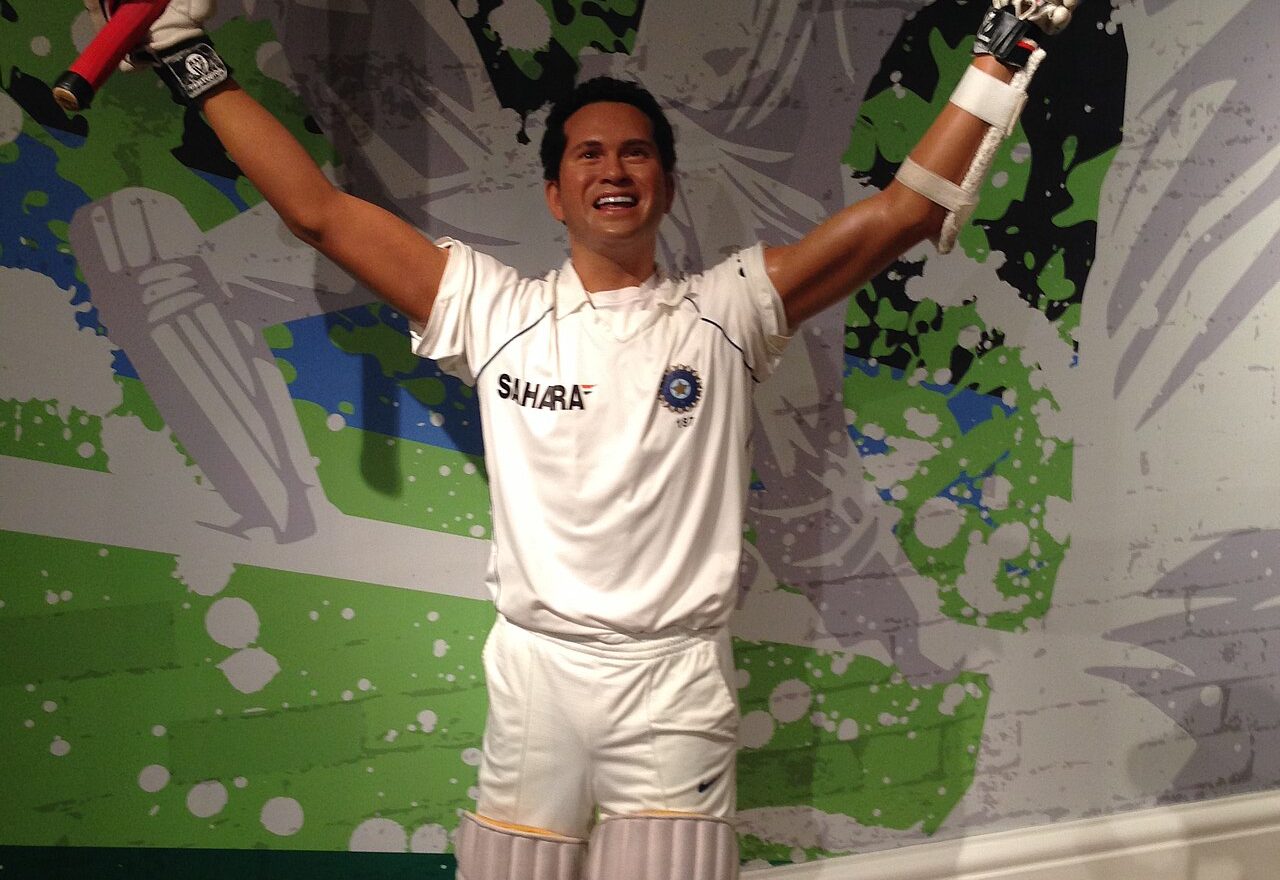
Photo: Luke Rauscher, CC BY 2.0, via Wikimedia Commons