When Rohit Sharma got to 264 against Sri Lanka at Eden Gardens in 2014, he did more than set the highest individual ODI score. He underlined a trait that had followed him since his early days in Mumbai cricket: once he settled, an innings could swell beyond normal limits.
That has happened often enough to define his career. Three ODI double hundreds, five centuries in a single World Cup, a long run as India’s white-ball opener and a trophy-laden spell as captain made Rohit Sharma one of the central batters of his generation. The numbers are huge, but the style mattered too. He made power look unhurried.
From Nagpur to Mumbai, and a change that shaped everything
Rohit Gurunath Sharma was born on April 30, 1987, in Nagpur, Maharashtra. Much of his cricket education, though, came in Mumbai, where he attended a camp in the late 1990s and studied at Swami Vivekanand International School and Junior College. That school became an important stop in his development, not least because coach Dinesh Lad saw more in him than a useful young off-spinner.
Early on, Sharma bowled off-breaks and was not yet fixed as a specialist batter. Lad pushed him toward batting, a decision that changed the course of his career. The boy who began as a bowling option grew into a right-handed top-order player with a gift for time and space: strong square of the wicket, superb on the pull, and unusually calm once the innings opened up.
A few stories from those years have lingered. He has reportedly spoken English, Hindi, Marathi and Telugu fluently. He has also recalled bunking school to catch a glimpse of Virender Sehwag, which sounds exactly like the sort of impulsive cricket obsession that marks out a teenager already hooked on the game.
Picked early, noticed before the usual milestones
Sharma’s rise did not follow the neatest domestic script. Before making his Ranji Trophy debut for Mumbai, he had already been picked for India A, a sign of how highly his talent was rated. His first-class debut came for India A against New Zealand A in Darwin in July 2006.
He would go on to represent Mumbai in India’s domestic system, and even then the outlines of his game were clear. There was elegance, yes, but not the empty kind. He could hit through the line, wait on the short ball, and shift gears quickly. Selectors were effectively betting that those gifts would stand up at a higher level. They were right, even if his international career took time to settle into its best shape.
An IPL journey that changed with Mumbai
The Indian Premier League gave Sharma an early stage and then a long-term home. He began with Deccan Chargers and was part of their title-winning side in 2009. In 2011, after three seasons with Deccan, he moved to Mumbai Indians at the auction. That switch became one of the defining turns of his franchise career.
At Mumbai, he grew from senior batter into captain and figurehead. Midway through the 2013 season he took over the leadership and led the side to the title that same year. More followed in 2015, 2017, 2019 and 2020. Five IPL trophies as captain put him alongside the most successful leaders the league has seen.
His batting record in the competition has been built more on consistency than on a stack of centuries. He has passed fifty regularly, played match-shaping innings at the top, and added useful off-spin on occasion. One statistical curiosity remains especially memorable: he is the only Indian player in IPL history to have scored a century and taken a hat-trick.
International debut and the slow build into a white-ball force
Sharma made his ODI debut for India against Ireland in Belfast on June 23, 2007. His T20I debut followed later that year, and he was part of India’s squad for the inaugural T20 World Cup in South Africa, where India lifted the trophy. It was an early high point, though his place in the side was not yet secure.
For a while, he was a player of obvious gifts and intermittent returns. India used him in the middle order, and the flashes were attractive without always being decisive. The major shift came later, when he was promoted to open in ODIs. That move gave his game room. He could start at his own pace, read conditions, and then stretch an innings deep.
Once established at the top, he became one of the format’s defining batters. His ODI record includes more than 11,000 runs and over 30 centuries, but the standout entries are the ones almost no one else can match. Sharma is the only man with three double centuries in ODI cricket. The biggest of them, 264, came against Sri Lanka in 2014 and remains the format’s highest individual score.
The 2019 World Cup was another peak. He scored 648 runs in the tournament and made five centuries, the most by any batter in a single men’s Cricket World Cup edition. It was not just a productive campaign; it was one of those tournaments where a player seems to shape the rhythm of the whole event.
In T20 internationals, he became just as significant in a different way. He was among the format’s most prolific run-scorers, hit five T20I hundreds, and shared the record for the most centuries in men’s T20Is for a period. He also featured in every men’s T20 World Cup from the inaugural edition in 2007 through to his retirement from the format after India’s title win in 2024.
Test cricket, delayed rewards and a second act as opener
His Test debut came against West Indies in Kolkata in November 2013, and it began brilliantly. Sharma scored 177 on debut and followed it with 111 in his next Test, immediately suggesting he had the technique and temperament for the longest format too.
But his red-ball career did not move in a straight line. There were gaps, changes in role and long stretches when he looked more secure in white-ball cricket than in Tests. The reinvention came in 2019, when India used him as a Test opener at home against South Africa.
He responded with a statement series. In the first Test at Visakhapatnam, he made 176 and 127, becoming the first batter to score twin hundreds in a Test on his first appearance as an opener. It was a rare feat and an important one, because it gave his Test career a fresh center of gravity.
By the time he stepped away from Test cricket in 2025, Sharma had scored more than 4,000 runs in the format, with 12 centuries. Those numbers do not place him in the very top bracket of Test accumulators, but they do tell the story of a player who found a second life in red-ball cricket after many had decided his future lay elsewhere.
Captaincy, trophies and a calmer kind of authority
Leadership became a major chapter rather than a side note. Sharma captained India in all three formats and often did it in the same way he batted at his best: with a sense of control that did not need much theatre.
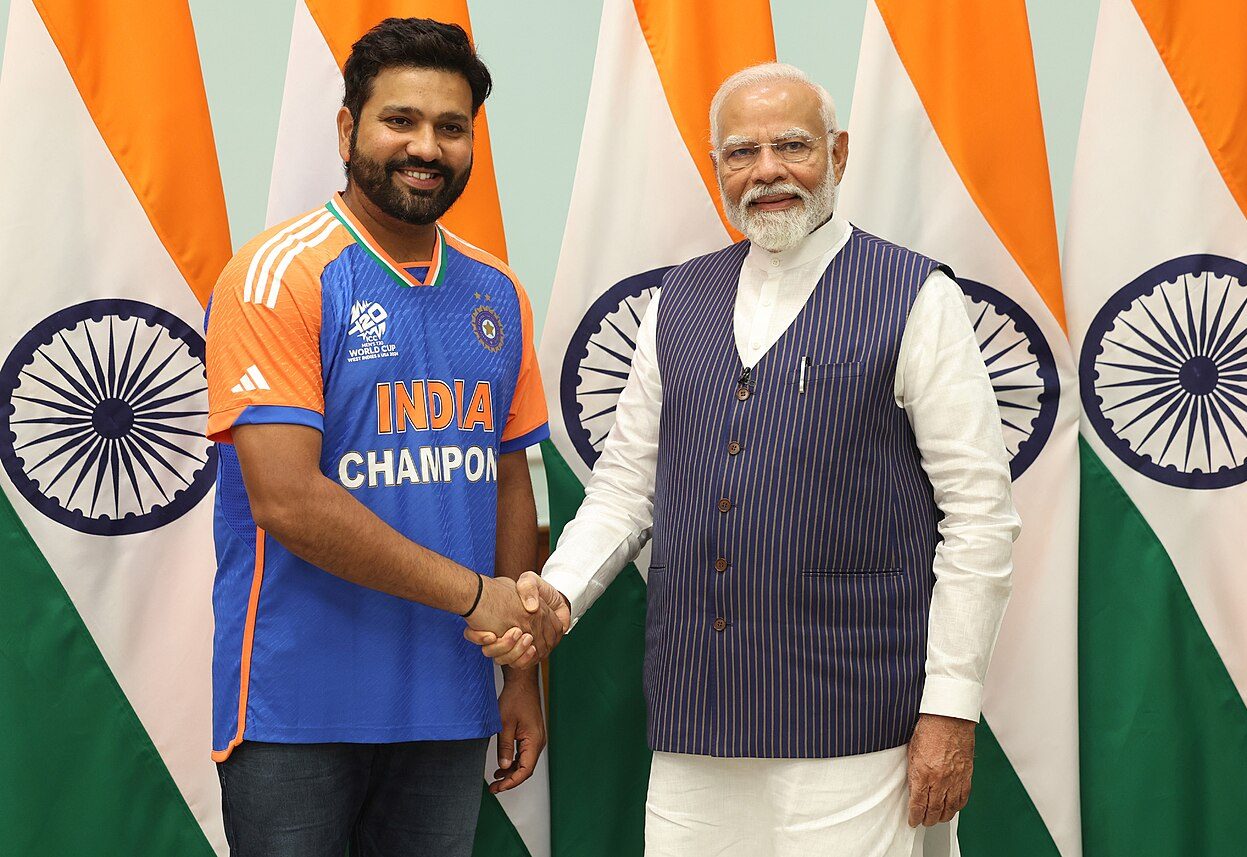
Before taking the full-time job, he had already led India to the 2018 Asia Cup and the Nidahas Trophy. Later came the 2023 Asia Cup, then the biggest ICC prize of his captaincy, the 2024 T20 World Cup. India followed that by winning the 2025 Champions Trophy under him as well.
His captaincy record in T20Is was especially strong. He became the first captain in men’s T20I history to lead a side to 14 consecutive wins, and he finished with 50 victories as T20I captain. Those figures help explain why he was trusted so heavily in tournament cricket, both by India and by Mumbai Indians.
As a player and captain combined, his honours list is substantial: the 2007 T20 World Cup, the 2013 Champions Trophy, the 2009 IPL with Deccan Chargers, and five IPL titles as Mumbai Indians captain.
Records, awards and what made his batting distinctive
Some players are remembered through technique, some through numbers. Sharma has both. The technique was based on balance, time and a remarkable ability to hit sixes without looking as if he was overreaching. The pull shot became a signature. So did the lofted drive that seemed to come from stillness rather than force.
His records reflect that blend of beauty and damage. He owns the highest individual ODI score, has the most double centuries in the format, and produced the most hundreds in a single men’s World Cup edition. He has also ranked among the leading six-hitters in international cricket.
The awards followed. Sharma received the Arjuna Award in 2015, the ICC Men’s ODI Cricketer of the Year award in 2019, the Major Dhyan Chand Khel Ratna in 2020, and the Padma Shri in 2025. He was also named multiple times in ICC Teams of the Year in ODI cricket and earned a place in the ICC Men’s Test Team of the Year in 2021.
Off the pitch: family, causes and the details that humanize the profile
Away from cricket, Sharma’s public life has usually been presented in a fairly grounded way. He married Ritika Sajdeh in December 2015, and the couple have children. He has also spoken at times about the importance of family support through the less certain phases of his career.
His off-field work has often centered on animal welfare and conservation. He has supported PETA campaigns, worked with WWF-India as a rhino ambassador, and used his platform to speak about marine pollution and the effects of plastic waste. During the COVID-19 crisis, he publicly donated to relief efforts.
There are lighter details too, though some belong more to anecdote than hard record. Sharma is widely described as an animal lover. He has also reportedly had a strong interest in aviation. Claims about his diet, language fluency or unusual food challenges circulate often online, but they are best treated as anecdotal unless directly confirmed by him or a reliable interview.
The same caution applies to money talk. Estimates of Rohit Sharma net worth vary sharply across entertainment and celebrity websites, and such figures are rarely verified in detail. It is safer to say that, as a long-serving India cricketer, IPL captain and endorsement figure, he has been among the game’s most commercially visible players.
FAQ
What is Rohit Sharma highest score in ODI cricket?
Rohit Sharma highest score in ODI cricket is 264, made against Sri Lanka in Kolkata in 2014. It remains the highest individual score in men’s ODIs.
How many double centuries has Rohit Sharma made in ODIs?
He has made three ODI double centuries, more than any other player in men’s one-day internationals.
When did Rohit Sharma make his India debut?
He made his ODI debut for India against Ireland on June 23, 2007. His T20I debut came later the same year, and his Test debut came in 2013 against West Indies.
Has Rohit Sharma won the IPL as captain?
Yes. He captained Mumbai Indians to five IPL titles: 2013, 2015, 2017, 2019 and 2020.
When did Rohit Sharma retire from T20I cricket?
He retired from T20I cricket after India won the T20 World Cup in June 2024.
Is Rohit Sharma involved in charity work?
Yes. His public causes have included animal welfare, rhino conservation, environmental awareness and donations to relief efforts.
Photo: Prime Minister's Office, GODL-India, via Wikimedia Commons