A hundred in a World Test Championship final. Another in a World Cup final a few months later. Player of the Match in both. Few modern Australian batters have built a reputation for arriving so decisively on the biggest days, and that is the thread that runs through Travis Head’s career.
He is a left-handed batter from Adelaide, capable of opening or batting in the middle order, and the kind of player who can alter a match in an hour. The strokeplay is obvious enough. What has made him more than a naturally aggressive hitter is the way he learned to balance tempo with judgment, first in South Australian cricket and then on the international stage.
Adelaide roots and a fast rise through South Australia
Travis Michael Head was born on December 29, 1993, in Adelaide, South Australia. His route into the game was local and familiar: junior cricket with Craigmore Cricket Club, school cricket at Trinity College, then age-group progression through South Australia’s under-17 and under-19 teams.
Senior cricket came early. Head made his first-class debut for South Australia in the 2011-12 season, still a teenager, and quickly looked like a player the state could build around. In 2015 he was appointed captain of South Australia at 21, becoming the youngest captain in the state’s first-class history.
That early version of Head already looked recognisable. He liked to score quickly, took on bowlers rather than waiting for them, and yet was not simply a swing-hard player. Even then, he could absorb pressure, settle, and then accelerate. That ability to change gears would become central to his game.
There was also an unsettling moment away from cricket. In January 2013, he was reportedly struck by a car outside an Adelaide hotel and suffered head and back injuries. He recovered and returned to playing, and the episode became a strange footnote in a career that was only just beginning.
Domestic cricket, captaincy and the Strikers years
Before the international spotlight, there was a long apprenticeship in domestic cricket. Head became a mainstay for South Australia and a regular for the Adelaide Strikers in the Big Bash League, where his attacking style was a natural fit.
One detail from his red-ball record says a lot about his development: his maiden first-class century did not arrive immediately. He had already made 17 scores of fifty or more before converting one into three figures. It was a reminder that his game was productive before it was polished.
In the BBL, the flashes were often more dramatic. On New Year’s Eve in 2015, playing for the Strikers, he made his maiden T20 century in a chase that turned frantic at the finish. Needing 55 from the final three overs, he reached his hundred and sealed the win with three consecutive sixes in the last over. It remains one of the standout innings of his domestic career.
Recognition followed. He was named Sheffield Shield Player of the Year in 2015-16, a sign that his output in Australian domestic cricket had moved beyond promise and into sustained performance.
County cricket added another layer. He spent time with Yorkshire in 2016, Worcestershire in 2018 and Sussex in 2021, gaining experience in different conditions and against different attacks. Those stints were useful for a batter whose international career was still taking shape.
International debut and the uneven early years
Head’s Australia debut came in T20I cricket against India in January 2016. His ODI debut followed against West Indies in June that year. The Test cap arrived later, against Pakistan in Dubai in October 2018.
The staggered timeline made sense. He was clearly talented, but his place was not always fixed. Australia used him in different roles and formats, and there were periods when he looked established followed by stretches when he had to rebuild his case.
One of those setbacks came in 2021, when he was left off Cricket Australia’s list of contracted players. The story became memorable because, according to widely reported accounts, selectors initially struggled to contact him as he was camping in the Flinders Ranges without phone reception. It was funny on the surface, but it also captured where he stood at the time: good enough to remain in contention, not secure enough to be untouchable.
He responded in the useful way players usually have to respond, with runs.
From counterattacker to match-winner in Tests
Head’s Test career changed shape once he became more than a busy middle-order option. He started turning games. Not always neatly, and not always conventionally, but decisively.
His Ashes performances were a big part of that rise. In the 2021-22 Ashes, he was one of Australia’s most influential batters and won the Compton-Miller Medal as Player of the Series. The innings were brisk, often disruptive, and frequently came at moments when matches needed to move.
Then came the knock that gave his Test career a different weight. In the World Test Championship final against India at The Oval in 2023, Head made 163 in the first innings and was named Player of the Match. It was the first century in a World Test Championship final, and it came in exactly the sort of situation that has come to define him: high stakes, strong attack, little room for hesitation.
By then, he was no longer simply a player with range. He had become one of Australia’s most important red-ball batters.
The World Cup final and a white-ball peak
If the WTC final gave Head a signature Test innings, the ODI World Cup final later the same year gave him an even wider audience.
Australia were chasing against India in Ahmedabad, under pressure and in difficult conditions, when he made 137. It was an innings of control as much as attack, built with judgment early and authority once he was set. He was named Player of the Match, just as he had been in the semi-final, and Australia won the tournament.
That hundred carried several layers of significance. It was the highest individual score in a men’s World Cup final while batting second, and it made him the first player to score centuries in both the World Test Championship final and a World Cup final.
Those are the innings that push a player out of the category of useful multi-format batter and into something more substantial. Not a myth, not a slogan, simply a cricketer with a record of delivering on the biggest stage.
T20 cricket, franchise moves and a growing market value
Head has never been a one-format specialist. His T20 batting, especially at the top of the order, has become increasingly valuable because he can seize a powerplay without looking reckless.
He has long been associated with the Adelaide Strikers, but his franchise career spread further. Royal Challengers Bangalore signed him for the IPL in 2016, though his first stint in the league was brief. Later came a much more significant return when Sunrisers Hyderabad bought him for the 2024 season. He also played in Major League Cricket for Washington Freedom.
As for money, published figures on contracts and salary can vary by outlet, especially when reports mix base retainers, match fees and franchise deals. The clearest confirmed IPL figure is that Sunrisers Hyderabad signed him for ₹6.8 crore for 2024. Claims about later retention values should be treated cautiously unless confirmed by the league or franchise.
The same care applies to broader estimates of Travis Head net worth. Media outlets often publish different totals, and those numbers are usually estimates rather than verified disclosures.
What makes his batting work
Head is left-handed, attacks square of the wicket well, and is particularly strong when he can put bowlers off their lengths early. He drives hard, cuts fiercely and is willing to take on spin. When he opens, he can break a game open in the first ten overs. In the middle order, he often functions as a momentum player, someone who can drag a match away from drift.
The more interesting part of his development is that he is not trapped by one tempo. Earlier in his career, the aggression could look like a fixed setting. Over time, he became better at reading the state of an innings. That is why some of his best hundreds have not been all-out assaults from ball one. They have had shape.
His bowling remains secondary but useful. As a right-arm off-spinner, he gives captains an extra option, particularly in white-ball cricket or when a partnership needs breaking.
Leadership and responsibility
Leadership has followed him for much of his career. He captained South Australia at a young age, and that responsibility arrived before he was fully established internationally. Australia have also used him in leadership groups, including as a Test vice-captain.
That matters because Head does not fit the old stereotype of the noisy on-field leader. His public manner is usually more relaxed than theatrical. The leadership has tended to show up in trust from selectors and teammates rather than in grand statements.
Life away from cricket
Off the field, the broad outlines of his personal life are public. He is married to Jessica Davies, and the couple have children. Beyond that, much of what circulates online about family routines, property, business interests and investments comes from lifestyle coverage or unverified reports, so it is best treated carefully unless backed by named, reliable sources.
One reported story that did gain attention concerned a major franchise offer. According to reports in outlets including The Age, The Sydney Morning Herald and Fox Sports, Head was offered a lucrative deal linked to full-time franchise cricket but chose to remain committed to Australia. Since financial details in such reports are not always independently confirmed, the existence of the offer can be described as reported rather than established fact.
There has also been unwanted attention around his family on social media after major matches. That kind of abuse was widely reported after Australia’s win in the 2023 World Cup final. It belongs to the modern reality of elite sport, though it says more about the online environment than it does about the player himself.
The shape of his career
Some careers are built on volume. Head’s is built on impact.
He has had the usual fluctuations of an international batter: selection doubts, role changes, technical questions, and periods when he seemed close to the centre of the side without fully owning that space. What changed was not just the run tally. It was the timing of the runs.
That is why his story reads differently now. South Australia gave him the base, domestic cricket gave him repetition, and international cricket eventually gave him the stage. On that stage, Travis Head has made a habit of producing innings that are hard to ignore.
FAQ
How old is Travis Head?
He was born on December 29, 1993.
Is Travis Head married?
Yes. He is married to Jessica Davies.
What is Travis Head’s role for Australia?
He is a left-handed batter who can open or bat in the middle order, and he also bowls part-time off-spin.
Which teams has Travis Head played for domestically?
He has played for South Australia and the Adelaide Strikers, and has also had county spells with Yorkshire, Worcestershire and Sussex.
What are Travis Head’s biggest international innings?
His 163 in the 2023 World Test Championship final and his 137 in the 2023 ODI World Cup final are the standout knocks.
What is Travis Head IPL salary?
The confirmed widely reported figure is ₹6.8 crore for Sunrisers Hyderabad in the 2024 IPL auction.
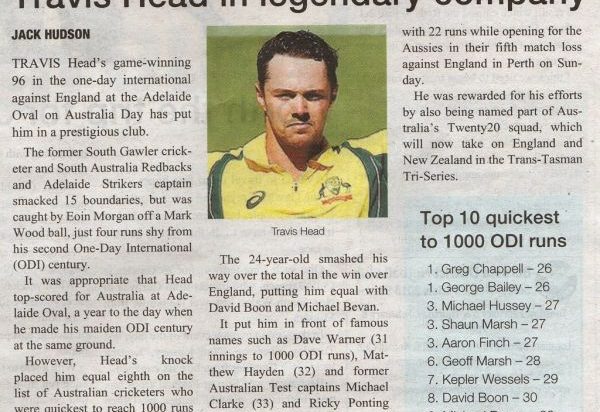
Photo: Gawler History, CC BY-SA 2.0, via Flickr