A debut Test hundred at Kanpur tends to stay with a player forever. For Shreyas Iyer, it became more than a memorable first impression: it captured the shape of his career. He has often arrived in important positions, taken on responsibility quickly, and scored with a mix of fluency and control that has made him a regular presence in Indian cricket across formats.
From Mumbai’s school and club system to the IPL captaincy circuit and India’s middle order, Iyer’s rise has not been a straight line. It has been built on heavy domestic seasons, white-ball consistency, and a growing reputation as a leader.
Early years in Mumbai
Shreyas Santosh Iyer was born on December 6, 1994, in Chembur, Mumbai, Maharashtra. He grew up in a family with roots across southern India: his father, Santosh Iyer, is from Kerala, while his mother, Rohini Iyer, is from Mangalore and is a Tulu speaker. He also has a sister, Shresta.
Like many Mumbai cricketers, his education and cricketing life ran side by side for a while before the game took over. He studied at Don Bosco High School in Matunga and later attended Ramniranjan Anandilal Podar College of Commerce and Economics. The more decisive classroom, though, was Shivaji Park Gymkhana, where he trained under former India batter Pravin Amre.
Accounts differ on exactly what age Amre first spotted him, so it is safer to say only that Iyer was identified early and developed in one of the most demanding cricket nurseries in the country. The talent was obvious, but so was the personality. His attacking style drew comparisons with Virender Sehwag in his younger days, and the nickname “Young Viru” followed him around age-group cricket.
One family detail has been widely repeated over the years: his mother reportedly used food as motivation, promising a burger for a fifty and pizza for a hundred. Whether or not that became a long-term training method, it fits the picture of a player whose progress was closely backed at home.
Before his senior breakthrough, he also spent time in England in 2014 with the Trent Bridge cricket set-up, part of the wider education many ambitious Mumbai batters seek before first-class cricket fully opens up.
The Mumbai seasons that changed everything
Stylish strokeplay can get a young batter noticed. Weight of runs is what gets him taken seriously.
Iyer represented Mumbai in domestic cricket and made his first-class debut during the 2014-15 Ranji Trophy season. The campaign that truly established him came a year later. In the 2015-16 Ranji Trophy, he piled up 1,321 runs, finishing as the tournament’s leading run-scorer. Only one player before him had crossed 1,300 runs in a single Ranji season. Mumbai went on to win the title, and Iyer was central to that success.
That season mattered because it answered two questions at once. He could bat attractively, yes, but he could also do the harder thing: score big, repeatedly, across a long red-ball competition. It showed endurance, concentration and the appetite to shape matches rather than merely decorate them.
His domestic record was not confined to first-class cricket. In the 2018 Vijay Hazare Trophy, he was again the leading run-scorer as Mumbai won the one-day title. By then, leadership had started to attach itself to his profile. He served as Mumbai’s vice-captain in that competition and also held captaincy roles with India A in both red-ball and white-ball cricket.
That combination, runs plus responsibility, would become a theme of his career.
IPL rise: Delhi launch, Kolkata title, Punjab move
The IPL introduced him to a much wider audience. Delhi Daredevils signed him ahead of the 2015 season for ₹2.6 crore, and he made an immediate mark. In his debut campaign, he won the Emerging Player award after scoring freely in the middle order and looking entirely at home against established attacks.
He stayed with the franchise through its transition from Delhi Daredevils to Delhi Capitals and eventually moved from promising batter to captain. In 2018, he took over the leadership role and became the youngest captain in the franchise’s history. His time in charge ran through 2021 and helped sharpen his image as a composed, tactically engaged cricketer rather than only a run-maker.
A new chapter began when Kolkata Knight Riders bought him ahead of the 2022 IPL. Injury interrupted that stint: a back problem ruled him out of the 2023 season, with Nitish Rana leading KKR in his absence. But Iyer returned to captain the side in 2024 and led them to the IPL title, the franchise’s third.
That trophy was significant. Captains in franchise cricket are often judged not just by style or calmness but by whether they can carry a team through a full season and finish the job. With Kolkata, he did exactly that.
He later moved to Punjab Kings, adding another major franchise to his career. The transfer itself underlined his value in the league: not only as a middle-order batter, but as a captain teams trust with structure and direction.
India call-up and the formats that shaped him
His India debut came first in T20 internationals against New Zealand in November 2017. An ODI debut followed a month later, against Sri Lanka in December 2017. The Test cap arrived later, in November 2021 against New Zealand in Kanpur, and it could hardly have been scripted better.
Iyer made 105 in the first innings and followed it with 65 in the second. That made him the first Indian batter to score a century and a fifty on Test debut, and he was named Player of the Match. It was a rare kind of entrance: not a brief flash, but a performance that immediately entered the record books.
His white-ball career, though, has been even more important to his standing. In ODI cricket, he settled into a role India have long treated as crucial: the No. 4 position. It is a slot that can demand repair work after early wickets, tempo control through the middle overs, and acceleration at the back end. Iyer’s game has often suited all three.
One of his most eye-catching ODI moments came against West Indies in December 2019, when he scored 31 runs in a single over, the most by an Indian in men’s ODIs. But his bigger statement came on the tournament stage.
At the 2023 ODI World Cup, he scored 530 runs in 11 matches as India finished runners-up. His tournament included two centuries and three fifties, and the volume of runs from the middle order stood out. He became the first batter at No. 4 or lower to score more than 500 runs in a men’s ODI World Cup edition.
That campaign reinforced what selectors and team management had increasingly trusted: he was not simply filling a position, he was defining it.
Test questions, technical scrutiny and adaptation
Iyer’s game has not been discussed only in glowing terms, nor should it be. Like many Indian batters, he has faced scrutiny over how his technique holds up in SENA conditions, South Africa, England, New Zealand and Australia, where pace, bounce and movement ask different questions.
There was also a period when he moved out of India’s Test plans after a lean run. That is part of the story too. His career has included pauses, injury interruptions and technical examination, particularly around the short ball and his methods against high pace.
What has kept him relevant is adaptation. Coaches and observers have pointed to improvements in those areas over time, and his broader record shows a batter willing to adjust rather than remain fixed in one version of his game.
He is primarily selected for his batting, but he can also offer occasional right-arm leg-breaks.
How Shreyas Iyer bats
The first impression is usually timing. He is a right-handed batter whose best innings often combine clean shape with quick scoring. He is strong through the off side, especially on the drive, and comfortable taking on spin in the middle overs.
What makes him useful, especially in one-day cricket, is flexibility. He can rebuild after wickets, rotate strike, and then shift gears without making the innings look frantic. That balance between control and intent has been one of the main reasons he has been trusted in top-order and middle-order roles.
In T20 cricket, the same qualities have made him more than a stylist. He is capable of anchoring an innings, but he is also experienced enough to manage a chase, absorb pressure and target match-ups.
Off the pitch: family, habits and the details that stick
Away from the field, Iyer remains closely associated with Mumbai. He has built a visible commercial profile and has worked with brands including BoAt, Manyavar, Dream11, CEAT and Google Pixel.
Some of the most memorable details about him are the less formal ones. Before becoming an IPL player, he was a ball boy during the league’s early years, a small detail, but one that neatly captures how close he was to the stage long before he stepped onto it. He is also known among teammates for card tricks and has often been described as an enthusiastic sneaker collector; reports about the exact size of that collection vary, so it is best treated as part of his public image rather than a fixed number.
He has spoken in multiple Indian languages, including Hindi, Marathi and Tamil, and he is known to enjoy football and badminton away from cricket. Reports and social-media posts have also highlighted his care for stray dogs, a detail that has added a softer edge to an otherwise intensely competitive public persona.
As for his personal life, publicly available information centers mostly on his family. There is no confirmed public record of a spouse, and relationship rumors should be treated as unverified unless he addresses them himself.
A career still defined by substance
There are flashier cricketers and louder ones. Iyer’s case has usually rested on something sturdier: runs in domestic cricket, important ODI contributions, a memorable Test debut, and a leadership record that has grown with each new assignment.
That is why his place in Indian cricket has lasted. He has not built it on one format alone, or on one season, or on one image. He has built it the long way, through volume, responsibility and the ability to matter in the middle of the game.
FAQ
What is Shreyas Iyer’s full name?
Shreyas Santosh Iyer.
When was Shreyas Iyer born?
He was born on December 6, 1994.
Where is Shreyas Iyer from?
He was born in Chembur, Mumbai, Maharashtra, India.
Which IPL teams has Shreyas Iyer captained?
He has captained Delhi Capitals and Kolkata Knight Riders. He has also been associated with leadership roles after moving to Punjab Kings.
What is Shreyas Iyer’s Test debut record?
On Test debut against New Zealand in November 2021, he became the first Indian batter to score a century and a fifty in the same debut match.
What is Shreyas Iyer’s batting style?
He is a right-handed batter known for clean strokeplay, strong play against spin and versatility in the top and middle order.
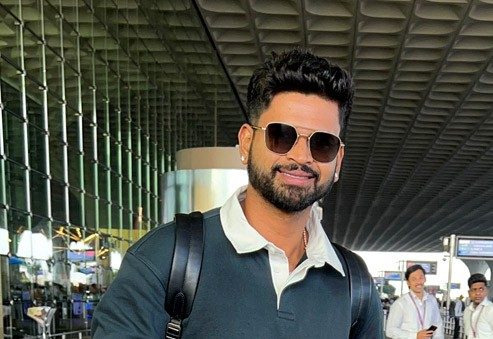
Photo: https://www.bollywoodhungama.com, CC BY 3.0, via Wikimedia Commons