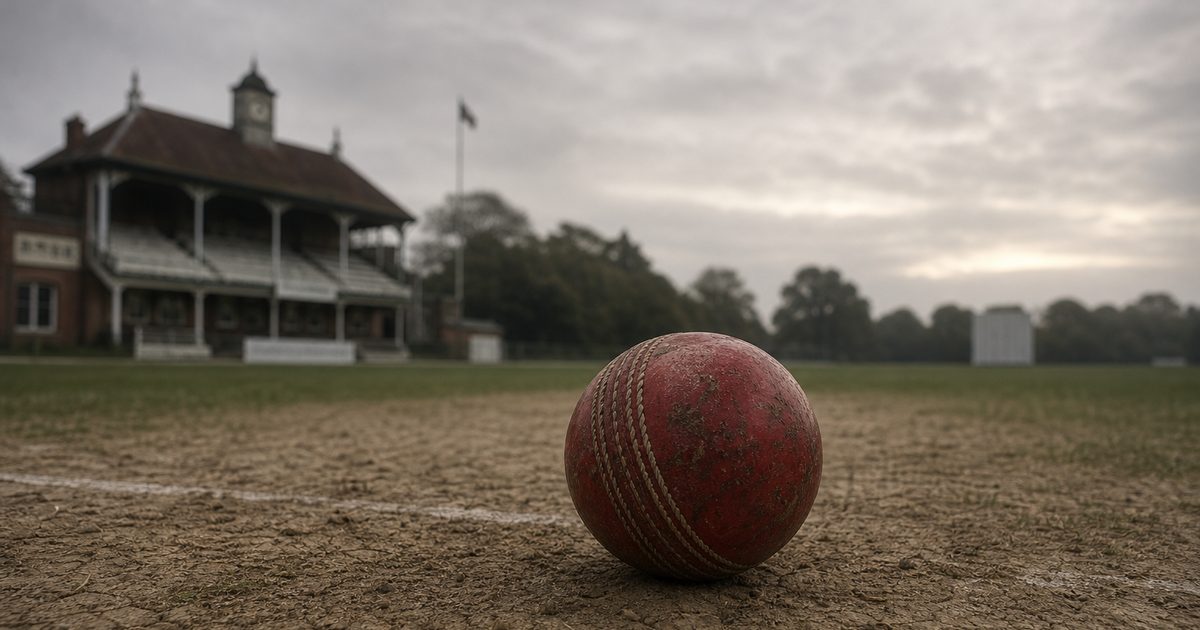
704 Test wickets is the headline number, but it never really explains James Anderson on its own. What made him different was the way he got there: not through intimidation or extreme pace, but through seam position, patience and that late movement outside off stump that kept drawing edges for more than two decades.
From Burnley club cricket to Lancashire’s first team
James Michael Anderson was born on July 30, 1982, in Burnley, Lancashire. Cricket was part of his world early. He spent time around Burnley Cricket Club as a boy and even worked as a scorer for the club’s second XI, a small detail that fits the rest of the story: long before England caps and Lord’s honors, he was simply immersed in the game.
His route was a Lancashire one. He came through Burnley Cricket Club, represented the Lancashire Cricket Board in 2000 and played for Lancashire’s second XI in the same period. A growth spurt in his late teens helped change his bowling. He had been a promising young cricketer already, but added pace as his body developed, and that gave county coaches something more serious to work with.
The rise was quick. Anderson made his first-class debut for Lancashire in 2002 and won the NBC Denis Compton Award that same year. He was noticed so quickly, in fact, that he played for England before he had even received his county cap.
Lancashire remained the base throughout his career. He also had an overseas stint with Auckland in 2007-08, but county cricket was always central to his development and identity. One of the major team moments came in 2011, when Lancashire won the County Championship.
England call-up came fast
His international debut arrived in ODI cricket against Australia on December 15, 2002. The Test debut followed against Zimbabwe at Lord’s on May 22, 2003, and his T20I debut came later, on January 9, 2007, also against Australia.
That early England period moved at speed. Anderson was selected for the 2003 Cricket World Cup while still at the start of his career, a sign of how highly he was rated. In those first years he was seen as a gifted swing bowler with obvious upside, though not yet the relentlessly precise Test operator he would become later.
He played 194 ODIs for England and took 269 wickets at 29.22, making him England’s leading wicket-taker in the format. He also scored 273 runs. He was the first England bowler to take an ODI hat-trick and finished with two five-wicket hauls in one-day internationals.
His T20I record was much smaller: 19 matches and 18 wickets. The format never became the main stage for him. His strengths were better suited to longer spells, changing conditions and the slow construction of pressure.
The format that defined him
Test cricket is where the full shape of Anderson’s career appears. He played 188 Test matches for England and finished with 704 wickets at an average of 26.45. With the bat, he scored 1,353 runs at 8.96, with a highest score of 81 and one half-century.
Those numbers place him in rare territory. He became the most successful fast bowler in Test history, the first pace bowler to reach 600 Test wickets, and later the first to reach 700. He also finished as England’s all-time leading Test wicket-taker and England’s most-capped men’s Test cricketer.
Durability was a huge part of the achievement. Anderson bowled 40,037 deliveries in Test cricket, the most by any fast bowler. He took 32 five-wicket hauls and three 10-wicket match hauls, figures that show not just longevity but repeated match-winning influence.
Some of the records say a lot about how he bowled. At Lord’s, he took 123 Test wickets, the most by a fast bowler at a single venue. In Tests, 249 of his wickets were caught by the wicketkeeper, another record, and one that perfectly suits his method: full enough to threaten, straight enough to hold attention, and moving late enough to take the edge.
There were quirks too. He shared a world-record 198-run 10th-wicket partnership with Joe Root against India at Trent Bridge in 2014. He also finished Test innings not out 113 times, a record in itself.
In February 2023, aged 40, he returned to No. 1 in the ICC men’s Test bowling rankings, becoming the oldest bowler to hold that position.
Ashes years and major series
Every long England career is measured, in part, by the Ashes, and Anderson’s was no different. He was part of four Ashes-winning campaigns: 2005, 2009, 2010-11 and 2013. The 2010-11 series in Australia stands out in England cricket because it ended with a rare away Ashes triumph.
There were important performances beyond Australia too. In 2008, he was named Player of the Series against New Zealand, one of the early signs that he was becoming more than a promising swing bowler. He was turning into England’s attack leader.
His name later became attached to one of the game’s major bilateral contests. The England-India Test series trophy was renamed the Anderson-Tendulkar Trophy, reflecting his place in that rivalry and in the modern Test game more broadly.
How James Anderson bowled
Some fast bowlers announce themselves with violence. Anderson did it with control.
He was a right-arm fast-medium bowler, left-handed batter, and at his best he could swing the ball both ways while landing it on a demanding line for over after over. The outswinger to right-handers became his signature, but the fuller picture was more subtle than one delivery. He could wobble the seam, straighten the ball from a similar release, and make batters play when they wanted to leave.
That is why the phrase King of Swing stuck, even if nicknames can sometimes overstate things. In his case, it described the central craft of his career. He was not built around raw speed. He was built around repeatability, feel, and the ability to read conditions quickly.
Over time, he became even more skilful. Early Anderson could be dangerous. Later Anderson could control an entire passage of play.
Honors and recognition
The awards came in stages, matching the shape of his career. He won the NBC Denis Compton Award in 2002, was named one of Wisden’s Cricketers of the Year in 2009, and received England’s Player of the Year award in 2012.
He was appointed MBE in 2015. He was later knighted for services to cricket.
At Lord’s, the Pavilion End was renamed the James Anderson End in 2024, a rare tribute at England’s most symbolic ground and a measure of how closely he had become associated with the place.
Flashpoints in a long career
A career that stretched across so many series was never going to be free of tension.
In 2014, during India’s tour of England, Anderson was involved in a disciplinary case concerning Ravindra Jadeja. Jadeja alleged that Anderson had abused and pushed him after play in Nottingham. Anderson denied the allegation, England lodged a counter-complaint, and the charge against Anderson was later dismissed by an ICC judicial commissioner for lack of sufficient evidence.
During the 2017-18 Ashes, television images prompted discussion on social media about possible ball tampering. Umpires spoke to Anderson and Joe Root during the match. No charge followed, and Anderson said he had only been removing dirt from the ball.
At Lord’s in 2021, tempers rose during England’s Test against India after Jasprit Bumrah bowled a hostile short-ball spell at Anderson late in the match. The episode fed into the tension between the sides and became one of the talking points of that Test.
An unrelated controversy surfaced when old tweets from Anderson reappeared publicly around the time of the Ollie Robinson debate. He later deleted historical posts.
Life away from the field
Off the pitch, Anderson has often come across as drier and funnier than his on-field image suggests. He has been one of the voices on the BBC Radio 5 Live podcast Tailenders, where the mood is looser and more self-aware than the intensity of a Test match.
He is married to Daniella Anderson, formerly Daniella Lloyd, and they have two daughters. Those family details are well established in public reporting. Claims about property holdings, luxury homes or wider investments are often repeated online, but unless Anderson or a reliable published source has confirmed specifics, they are better treated cautiously.
The same applies to net-worth figures. Estimates of career earnings and personal wealth vary widely across outlets and are rarely verified in detail, so they should be read as unconfirmed media estimates rather than settled fact.
In 2024, he published his autobiography, Finding the Edge, adding his own version of the story after years in the public eye.
The finish of an England career
Anderson retired from international cricket after his final Test against the West Indies at Lord’s in July 2024. By then, the shape of his record was fixed: 188 Test matches, 704 wickets, 194 ODIs, 269 wickets in that format, and a place at the top of the list for fast bowlers in Test history.
That did not mean the end of cricket altogether. After stepping away from England duty, he continued his long association with Lancashire.
The numbers will always lead any summary of James Anderson. They should. But they do not quite capture the feel of watching him at work: the upright seam, the late curve, the slips waiting, and the sense that a batter could do everything right for three balls and still edge the fourth.
FAQ
How many Test wickets did James Anderson take?
He took 704 wickets in 188 Test matches for England.
When did James Anderson make his England debut?
His ODI debut came against Australia in December 2002, and his Test debut came against Zimbabwe in May 2003.
Is James Anderson the highest wicket-taking fast bowler in Test cricket?
Yes. He finished with more Test wickets than any other fast bowler.
How many ODIs did James Anderson play?
He played 194 ODIs and took 269 wickets.
What is James Anderson known for?
He is best known for swing bowling, especially his control and late movement outside off stump.
Is James Anderson married?
Yes. He is married to Daniella Anderson, formerly Daniella Lloyd.