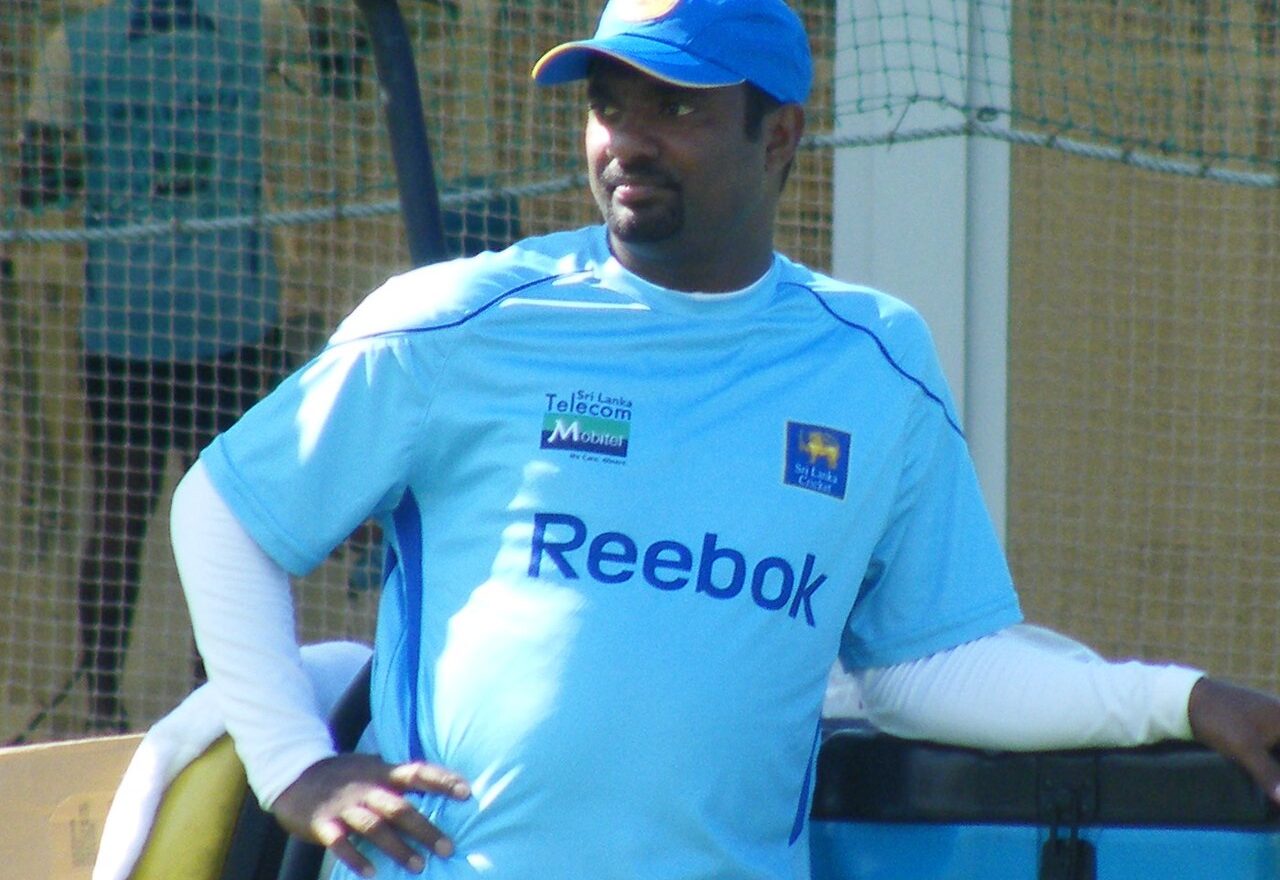
Eight hundred Test wickets is the headline, but it never tells the whole Muttiah Muralitharan story. His career sits at the meeting point of numbers, mystery and argument: a Sri Lankan off-spinner from Kandy who turned matches with huge revolutions on the ball, a bent arm that drew constant scrutiny, and a record book that still carries his name in bold.
From Kandy schoolboy to specialist spinner
Deshabandu Muttiah Muralitharan was born on April 17, 1972, in Kandy, Sri Lanka, the eldest of four sons of Sinnasamy Muttiah and Lakshmi. He grew up in a Tamil family with roots in Sri Lanka’s plantation history; his grandfather had come from South India to work on tea estates. The family also ran a biscuit business, a detail that would remain part of his life long after cricket took over.
At St. Anthony’s College in Kandy, sport was not limited to cricket. He played rugby too, and in his early cricket years he was not even a spinner. Muralitharan began as a medium-pacer before school coach Sunil Fernando urged him, at 14, to switch to off-spin. That decision changed everything.
He represented the school First XI for four years and quickly became the kind of bowler opponents remembered. The action was unusual even then, though not yet a global talking point. Years later, one of the more revealing details from his youth emerged: he reportedly did not see his own bowling action on television until his late teens, by which point he was already playing serious cricket.
His preferred spelling has often been noted as “Muralidaran,” but the cricket world came to know him as Muttiah Muralitharan, or simply Murali.
Domestic cricket and the long apprenticeship
Before the records and the international spotlight, there was domestic cricket with Tamil Union Cricket and Athletic Club. He made his first-class debut in the 1991-92 season, and Tamil Union remained a central part of his Sri Lankan domestic career through 2009-10. He also represented Central Province.
Those years mattered. They gave him overs, responsibility and the chance to develop the control that would later make him so hard to survive against. He was never just a bowler of mystery deliveries. Volume, stamina and relentless accuracy were just as important to his rise.
County cricket in England added another layer. Muralitharan played for Lancashire in 1999, 2001, 2005 and 2007, and for Kent in 2003. English conditions did not reduce his threat; if anything, they showed how adaptable he was. On flatter pitches, in damp weather, under heavy workloads and often before skeptical crowds, he kept taking wickets.
Later came franchise cricket. In the IPL, he played for Chennai Super Kings from 2008 to 2010, then for Kochi Tuskers Kerala in 2011, and Royal Challengers Bangalore from 2012 to 2014. Reported contract figures have varied in media coverage, so they are best treated as estimates rather than settled fact.
He also appeared for Gloucestershire, Wellington Firebirds, Chittagong Kings, Melbourne Renegades and Jamaica Tallawahs as T20 leagues spread across the cricket calendar. By then, he was no longer building a name. He was carrying one of the game’s heaviest wicket-taking reputations from country to country.
Sri Lanka debut and a career that kept expanding
Muralitharan made his Test debut for Sri Lanka against Australia at Colombo on August 28, 1992. His ODI debut followed against India on August 12, 1993. Much later, when T20 internationals arrived, he played his first T20I against New Zealand on December 22, 2006.
What followed was not a quick burst but a long accumulation of wickets on a scale no spinner had managed before.
In Test cricket, he played 133 matches and took 800 wickets at an average of 22.72. He retired from the format in July 2010, fittingly by taking his 800th wicket in his final Test, against India at Galle. He remains the only bowler to reach that mark.
The supporting numbers are just as striking: 67 five-wicket hauls and 22 ten-wicket match hauls, both Test records. He was also the fastest bowler to reach a long list of milestones, including 350, 400, 450, 500, 550, 600, 650, 700 and 800 Test wickets.
His ODI career was almost as extraordinary in volume. Across 350 one-day internationals, he took 534 wickets at 23.08, still the record in that format. He retired from ODI cricket after Sri Lanka’s run to the 2011 World Cup final. In T20Is, he played 12 matches and took 13 wickets.
Add the formats together and the total reaches 1,347 international wickets, another world record.
There were odd, almost unbelievable feats along the way. He is the only bowler to take 10 or more wickets in a Test match in four consecutive Tests, and he did it twice. That says as much about endurance and repeat pressure as it does about skill.
Big tournaments and Sri Lanka’s rise
Muralitharan’s career unfolded alongside Sri Lanka’s emergence as a major force. He was part of the squad that won the 1996 Cricket World Cup, the defining title in the country’s cricket history, though he was not yet the finished version of the bowler who would dominate the next decade.
He also helped Sri Lanka share the 2002 ICC Champions Trophy with India. Later came two more World Cup final appearances, in 2007 and 2011. Those teams did not lift the trophy, but his place in Sri Lanka’s strongest modern sides was constant.
Individual recognition followed. Wisden named him one of its Cricketers of the Year in 1999, and he was selected as the Wisden Leading Cricketer in the World in 2000 and 2006. He entered the ICC Cricket Hall of Fame in 2017, the first Sri Lankan cricketer to receive that honor.
The bowling itself: drift, dip, spin and doubt
Some bowlers are remembered through highlights. Muralitharan is remembered through a feeling batters had at the crease: uncertainty.
He bowled right-arm off-spin, but that label only goes so far. His method relied on extraordinary wrist work, sharp shoulder rotation and a delivery stride that looked unlike anyone else’s. The ball dipped late, bit hard and often turned more than batters expected. His doosra, which moved away from a right-hander, added another problem. Picking him from the hand was difficult; surviving him for long spells was harder.
That unusual action, of course, became one of the biggest controversies in modern cricket.
He was called for throwing by umpire Darrell Hair during the 1995 Boxing Day Test in Melbourne, and later by Ross Emerson in an ODI series. Critics focused on the appearance of elbow flex at release and argued that his method was illegal.
The official record is important here. Muralitharan’s action was examined repeatedly, and he was cleared by the ICC after biomechanical testing in 1996 and again in 1999. Testing found that his arm had an unusual congenital bend and hyperextension, which affected how the action looked to the eye. His doosra later came under separate scrutiny: under the old 10-degree tolerance for spinners, it was initially judged to exceed the limit in testing. In 2005, when the ICC adopted a 15-degree standard for all bowlers, that delivery fell within the legal threshold.
The debate never fully disappeared in public, but across his international career he was not suspended from bowling in international cricket for an illegal action. Any account of Muttiah Muralitharan has to hold both truths at once: the controversy was real, and so were the governing body’s repeated clearances.
Life away from the game
Off the field, Muralitharan’s life has remained relatively grounded in public view. He married Madhimalar Ramamurthy on March 21, 2005, and they have a son, Naren, born in January 2006.
Business stayed close to his roots through the family’s biscuit company, while charity work became another visible part of his post-playing identity. He has been associated with the Foundation of Goodness and with reconstruction and relief efforts after the 2004 Indian Ocean tsunami.
Retirement from playing did not mean leaving cricket. He moved into coaching and mentoring roles, most notably in the IPL. He was part of the Sunrisers Hyderabad support staff when the franchise won the 2016 IPL title.
As for wealth estimates, published figures on Muttiah Muralitharan net worth vary widely and are not officially confirmed. Any total should be treated as media estimation, not established fact.
Legacy in full
The simplest version of the story is the easiest to remember: most Test wickets, most ODI wickets, most wickets in international cricket. But the fuller picture is more interesting than a list.
Muralitharan came from Kandy, changed from medium pace to off-spin as a teenager, built himself through domestic cricket, and then pushed spin bowling into statistical territory nobody had reached before. He did it while carrying a technique that fascinated some observers and angered others, and while remaining central to Sri Lanka’s strongest era in world cricket.
That is why his career still invites discussion. Not because the numbers need decoration, but because they were made in such an unusual way.
FAQ
How many Test wickets did Muttiah Muralitharan take?
He took 800 wickets in 133 Test matches, the most by any bowler in Test cricket.
How many ODI wickets did Muttiah Muralitharan take?
He finished with 534 wickets in 350 ODIs, which is still the world record in one-day internationals.
When did Muttiah Muralitharan retire from international cricket?
He retired from Test cricket in July 2010 and played his last ODI in the 2011 World Cup final. His international career ended in 2011.
Was Muttiah Muralitharan’s bowling action legal?
His action was controversial and was reported by umpires, but the ICC cleared him after biomechanical testing. He was not suspended from international cricket for an illegal action.
Did Muttiah Muralitharan win a World Cup?
Yes. He was part of Sri Lanka’s 1996 Cricket World Cup-winning squad.
What is Muttiah Muralitharan’s biggest record?
His biggest records are 800 Test wickets, 534 ODI wickets and 1,347 wickets across international cricket, all world records.
Photo: NAPARAZZI, CC BY-SA 2.0, via Wikimedia Commons