Three ODI hundreds in a row against India before his 21st birthday tends to change the way a player is seen. Quinton de Kock did that in the space of one breakout series, and from there his career moved quickly: international opener, all-format wicketkeeper, South Africa captain, global franchise regular.
Born in Johannesburg on December 17, 1992, de Kock built his reputation on two things that are hard to teach: speed of thought and speed of hands. At the crease, that meant early pressure on bowlers. Behind it, it meant clean takes, sharp stumpings and the kind of glovework that can shift a match in a session.
He has never been a noisy public figure. The cricket has usually done the talking.
From Johannesburg school cricket to the domestic game
De Kock grew up in Johannesburg and attended King Edward VII School, one of South Africa’s well-known cricket nurseries. Before cricket became the main road, he also played baseball, and that background is sometimes mentioned when people talk about his hand-eye coordination and quick reactions.
His progress through youth cricket was swift. He represented Gauteng and captained South Africa Under-19, moving from gifted schoolboy to serious prospect while still in his teens. Coaches around him saw obvious natural talent, but they also noted that his game sharpened once discipline and work habits caught up with that talent.
His senior domestic career began with Gauteng, and he later played for the Highveld Lions before moving into the Titans setup. Those early years mattered. They gave him regular cricket, a stronger professional routine and a clearer sense of where he fit best: as an attacking left-handed wicketkeeper-batter who could change the tempo of an innings from the top order.
The first domestic silverware arrived with the Lions in South Africa’s T20 competition, a useful sign that his game was already well suited to the shortest format.
A franchise career that stretched across the cricket map
Long before franchise cricket became the default rhythm for elite players, de Kock was already in demand. His IPL journey began with Sunrisers Hyderabad in 2013, but it was later spells that defined his tournament story more clearly.
He turned out for Delhi Daredevils and Royal Challengers Bangalore before landing at Mumbai Indians, where team success followed. With Mumbai, he was part of title-winning campaigns in 2019 and 2020, and his role was familiar by then: left-handed opener, quick starter, wicketkeeper, pressure-maker.
One of the biggest individual knocks of his league career came for Lucknow Super Giants in IPL 2022, when he hammered 140 not out from 70 balls against Kolkata Knight Riders. It was a classic Quinton de Kock innings, hard hands through the off side, clean hitting down the ground, and bowlers forced onto the defensive almost from the start.
Beyond the IPL, his passport filled up quickly. He has played in The Hundred for Southern Brave, in Australia’s Big Bash League for Melbourne Renegades, in SA20 for Durban’s Super Giants, in Major League Cricket for Seattle Orcas, and in other short-format competitions including the T10 circuit. That spread says plenty about how his game travels. Pace, spin, new ball, old ball, different surfaces, his method has generally remained the same: attack what is there early and make the fielding side react.
Some contract figures and future franchise listings in earlier versions of his biography were either too specific to verify cleanly or extended beyond firmly established fact. What is clear is the broader picture: de Kock became one of the most recognisable wicketkeeper-openers on the global franchise circuit.
The international breakthrough came in white-ball cricket
His South Africa debut arrived in T20 internationals against New Zealand in December 2012. An ODI debut against the same opposition followed in January 2013. The Test cap came later, against Australia in February 2014.
It was ODI cricket, though, that gave him lift-off.
In late 2013, South Africa played India and de Kock produced the sequence that changed his profile: scores of 135, 106 and 101 in three consecutive ODIs. Three hundreds in a row against an attack of that quality was headline material on its own. The age made it even more striking. He was still only 20.
That run was not a brief flash. By his 20th ODI, he already had five centuries. He became the fastest player to 12 ODI hundreds, reaching that mark in 74 innings, and for a period he looked as if every new-ball phase in one-day cricket was built for him. Width disappeared to the cut. Anything overpitched was driven. Bowlers trying to cramp him for room often found him strong enough to score square anyway.
Recognition followed. He was named in the ICC ODI Team of the Year and later won the ICC ODI Cricketer of the Year award for his work in the format. Cricket South Africa also named him its Cricketer of the Year.
His ODI record stands among the strongest of his generation for South Africa. In 155 ODIs, he scored 6,770 runs at an average a shade above 44, with 21 centuries and 30 half-centuries. His highest score in the format is 178 against Australia in Centurion in 2016, an innings that combined his usual tempo with the ability to bat deep.
Test cricket, responsibility and an early exit
When de Kock moved into Test cricket, the role changed slightly. He was still naturally attacking, but the format asked for more patience and more rescue work from the middle order. South Africa also needed him to carry the gloves, which added another layer of physical and mental load.
He still made a substantial contribution. Across 54 Tests, he scored 3,300 runs at an average of 38.82, with six centuries and 22 fifties. Those are strong numbers for a wicketkeeper-batter, especially in an era when South Africa’s Test side was going through transition.
Behind the stumps, he was just as valuable. He became the quickest wicketkeeper to reach 150 Test dismissals and later the quickest to 200, a measure of both skill and consistency rather than flair alone. His keeping had a compactness to it. He was rarely theatrical for the sake of it. The movement was efficient, the hands soft, the reactions quick.
Leadership arrived too. De Kock captained South Africa in white-ball cricket and also led the Test side for a period, including in the home series against Sri Lanka. It never felt like the central fact of his career, but it did show how highly he was regarded within the setup.
Then came a sharp turn. In December 2021, after the first Test against India, he announced his retirement from Test cricket. The decision was sudden in timing, but clear in intent: he wanted to focus on his young family and on the shorter formats.
White-ball mainstay and World Cup runs
Even after stepping away from Tests, de Kock remained central to South Africa’s limited-overs plans. In T20 internationals, he has been one of the side’s defining players of the modern era: an opener who can win the powerplay, keep wicket and set the tone in a format where starts matter disproportionately.
He has scored more than 2,500 T20I runs for South Africa and has registered two T20I centuries. Among his standout records is a 15-ball half-century, the fastest by a South African in men’s T20 internationals. His highest T20I score, 100 not out against West Indies, underlined the same trait that marked his ODI rise: once he gets ahead of the game, he can make bowlers feel very short of options.
At global events, his record has layers. He featured in the ODI World Cups of 2015, 2019 and 2023, and in multiple T20 World Cups as well. The 2023 Cricket World Cup was his richest ODI tournament. He scored 594 runs, including four centuries, and for long stretches he looked like one of the defining batters of the competition.
That tournament also carried a quirky statistical footnote: he had already made 17 ODI hundreds before scoring his first World Cup century, more than any other player before finally reaching three figures in the event.
There was also a brief and widely reported retirement twist in one-day cricket after that World Cup. Reports at the time said he had stepped away from ODIs, before returning to selection contention later. Because availability can shift in modern cricket, it is safer to frame that as a reported retirement and return rather than a fixed endpoint.
How Quinton de Kock plays
At his best, de Kock makes batting look simpler than it is. He sets up without fuss, sees length early and commits hard when he decides to attack. The strongest version of his game comes against the new ball, especially in white-ball cricket, where he can turn a cautious opening spell into a scramble.
He is not built around ornament. The value lies in timing, decisiveness and the pressure he creates. Bowlers know that a slightly short ball can disappear square, and a full one can be driven before they have settled into rhythm.
As a wicketkeeper, he has long offered more than a secondary skill. His reflexes standing back are sharp, and he has been especially effective up to the stumps in limited-overs cricket, where quick takes can create run-out and stumping chances that do not look available until he makes them.
Off the pitch: private by instinct, settled by reputation
Away from cricket, de Kock has generally kept a low public profile. He is married to Sasha Hurly, and the couple have a daughter. Those family details have been publicly reported, but he has rarely made his private life part of his public image.
He has often been described as someone who prefers quieter downtime, golf and fishing are regularly mentioned among his interests, and that fits the broader impression. He is not a player who has sought constant attention away from the field.
There have also been occasional glimpses of the person behind the cricketer rather than the performer. In one documented message, he thanked Maryland Youth Cricket for its work in growing the game, a small but genuine example of engagement beyond matches and contracts.
What stands out most, though, is consistency of character. Through school cricket, early fame, captaincy and the churn of the franchise calendar, de Kock has remained recognisably the same sort of cricketer: quick-scoring, low-key, highly skilled, and more comfortable letting an innings explain him than a quote ever could.
FAQ
How old is Quinton de Kock?
He was born on December 17, 1992.
What is Quinton de Kock’s role?
He is a wicketkeeper-batter, usually used as an opener in white-ball cricket.
Has Quinton de Kock retired from Test cricket?
Yes. He retired from Test cricket in December 2021.
What is Quinton de Kock’s highest ODI score?
His highest ODI score is 178 against Australia in 2016.
Which IPL teams has Quinton de Kock played for?
He has played for Sunrisers Hyderabad, Delhi Daredevils, Royal Challengers Bangalore, Mumbai Indians and Lucknow Super Giants.
Is Quinton de Kock married?
Yes. He is married to Sasha Hurly.
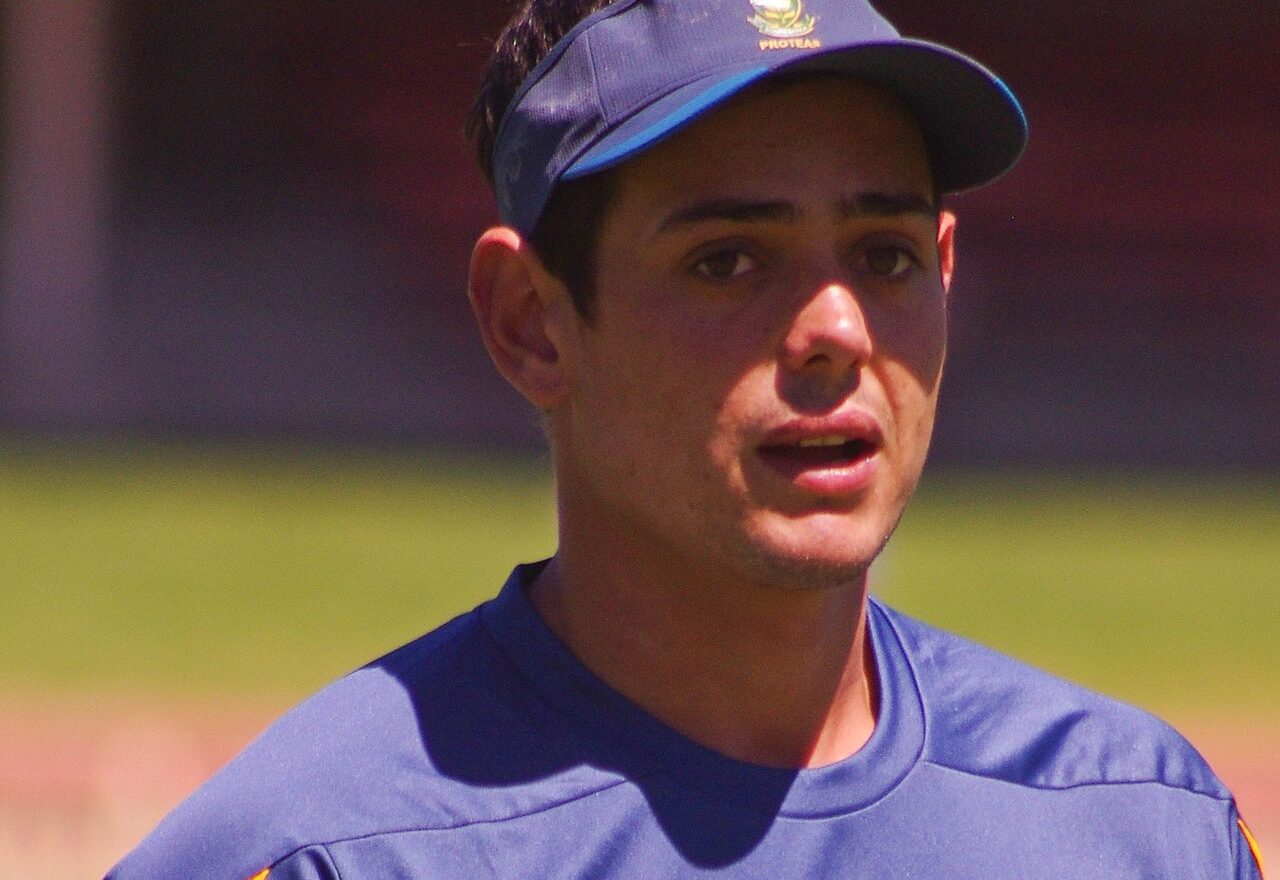
Photo: NAPARAZZI, CC BY-SA 2.0, via Wikimedia Commons